Showing posts with label sweet stuff. Show all posts

Saturday, August 27, 2011

Daring Bakers' August Challenge - Candy


The August 2011 Daring Bakers’ Challenge was hosted by Lisa of Parsley, Sage, Desserts and Line Drive and Mandy of What the Fruitcake?!. These two sugar mavens challenged us to make sinfully delicious candies! This was a special challenge for the Daring Bakers because the good folks at http://www.chocoley.com offered an amazing prize for the winner of the most creative and delicious candy!

Oh, boy. This month’s Daring Bakers’ challenge was a doozie. Candies, including one mandatory chocolate candy. Everyone knows working with chocolate is a bitch on any given day, but working with chocolate on a humid summer day? Really? Not to mention boiling sugar and the like…


Ok, I’m done with the complaining… at least for now. The truth is, even though there were many reasons to skip this challenge, there were also plenty of reasons to go for it. One of them being the amount of work our hostesses put into it: the instructions were so detailed and they left us so many recipes and options, I would’ve felt bad wimping out just because “chocolate is hard.” And another reason was… well, precisely that chocolate is hard. It’s a challenge, one that I was supposed to tackle a long time ago.

A few years back, Laurent’s dad was preparing a conference on chocolate, and we all got dragged into the research and trivia. We were all kind of obsessed with it, really. That’s how I got to be fairly well informed about the tempering process. Tempering consists in melting chocolate, cooling it down to a certain temperature, then heating it back up slightly. The aim is to obtain a specific type of crystallisation, which leads to a finished chocolate that is smoother, snappier, and shinier. Yup, I knew all about tempering… but I’d never actually done it. This was because I also knew how difficult it is to control the temperature of chocolate.


So, with that in mind, I started off with a non-chocolate candy: pâte de fruits. I’ve always liked these chewy squares of fruit paste, and the recipe looked pretty simple. I made a citrus grapefruit version, although the pink coloring I used makes it look more like strawberry. Unfortunately, I was pretty disappointed by my result. Maybe I didn’t use enough pectin, but my pâte de pamplemousse never solidified as much as I would have liked. I had to store it in the fridge, and it didn’t have that satisfying chewiness I love. Also, the humidity made it absorb too much sugar, making it too sweet.


With that, I decided to man up and tackle the chocolate. Truffles would have been an easy way out, as Laurent and I often make truffles in the winter. But if I was doing this, I was doing it right. I decided to make bonbons with a caramel filling: they would highlight the tempered chocolate, and allow me to use those cute little moulds we’d bought during our chocolate obsession. With a good supply of Alto El Sol chocolate disks of the Barry brand and a marble slab which was graciously given to us a while back, I was ready.


As predicted, it was difficult and frustrating. I waited until all the chocolate had melted in the double boiler to test the temperature, only to find that it was already past the recommended limit. I then transferred most of the chocolate to the marble slab, and started spreading it and flipping it around. But the temperature simply refused to drop lower than 28.5ºC, even going back up at times, never anywhere near the required 27 ºC. Finally, I got bored and decided that this would have to do. I put the chocolate back over barely simmering water, and this time the temperature shot back up and was past its limit before I could do anything. That’s when I stopped using the thermometer, as it was seriously screwing with my mind.

Moulding the bonbons was an exercise in frustration as well. Despite being apparently too hot, the chocolate was thick, and didn’t spread very well. Next time, I’m definitely using a pastry brush to fill the moulds individually, rather than trying to ladle chocolate over all the cavities: it’ll be slower, but definitely less messy. I’m sure professionals can pull it off, but I’m just not there yet.

Prior to this, I had made a filling of salted caramel (the original recipe was passion fruit, but I didn’t have any on hand). I have a habit of burning caramel, so I was careful this time, and the result was light and liquid – maybe a little too liquid, thus making the moulding even more difficult.


As I waited for the bonbons to set in the fridge, I cleaned up the kitchen, wiping melted chocolate off the counter, floor, walls, stovetop, and fridge handle. I was rather despondent at that point, as I was certain the result was going to be a huge fail. So when I banged the mould on the counter and a perfect, shiny chocolate candy popped out, I cursed in delight – which very rarely happens.

Of course, they didn’t all come out perfect. I’d say about half were edible, the others were either crushed or permanently stuck in the mould. Not great for a pound of chocolate, and I felt saddened by all the wastage. But I vow to be more careful next time, now that I have a better idea of how this works.

My tempering was most definitely not perfect, but it still seemed to have an effect: the chocolate had a distinctive texture as it snapped between my teeth. It remains to be seen whether the nice sheen of the bonbons will last over the days. But still, it’s nice to know all that trouble wasn’t a complete waste of time.


Lisa and Mandy, thank you so much for this challenge. Despite all my complaining, I really am glad that you pushed me to do this. Even though it didn’t go perfectly, tempering chocolate no longer seems like an impossible task.

Please check out the challenge recipes here at the Daring Kitchen, and take a look at the blog roll to see all the cute candies made this month.

Monday, August 22, 2011

The Particular Sadness of Lemon Cake - Lemon Pound Cake


As mentioned before, I’ve been reading a lot of food books lately: chef memoirs, books about specific foodstuffs, but also fiction about food. I’ve decided to add a new partial focus to this blog: commenting on these books (I don’t want to say “reviewing,” because I don’t plan on being nearly that systematic or authoritative) and including a recipe taken from or inspired from the book in question. Basically what I did with Devil’s Food Cake Murder last month. This way, I get the best of both worlds I love: cooking and reading.

The Particular Sadness of Lemon Cake was one of those books that I came upon accidentally at the store. The greenish-blue cover, quirky title font, and, of course, the title and the striking slice of triple-layer cake caught my eye as I was skimming the shelves, looking for Kate Atkinson’s latest novel. I had never heard of Aimee Bender, but after reading her book’s synopsis, I was too intrigued to leave it behind.


The narrator, Rose, is a happy, carefree nine-year-old girl at the beginning of the novel. The first scene is the kind of childhood memory everyone either cherishes or would like to have: she comes home from school to her smiling mother, who is just about to start baking her a birthday cake. But after one bite, Rose realizes something is very wrong: although the cake is objectively delicious and made from quality ingredients, she can taste something else in it, too. Hollowness, emptiness. Her mother’s mal-de-vivre.

Rose soon discovers, much to her despair, that, no matter what she eats, she can now taste the emotions of the person who prepared the food – even in something as basic as a sandwich. Imagine eating a bakery cookie and tasting the boredom and frustration of the person who made it. Or, even worse, finding out your mother’s deep, dark secrets by way of her roast beef.

The novel follows Rose through the years, as she deals with this gift/curse. The focus is also on her family, which appears fairly average, in that dysfunctional way that is so frequent in contemporary novels: her father, a pragmatic lawyer who seems to have achieved most of his personal ambitions, and who remains a distant figure most of the time; her mother, who struggles to discover what she wants in life and hides her inner void as best as she can; and her older brother, Joseph, a reclusive teen genius who grows up to be an even more reclusive young adult, with, as it turns out, a gift of his own.

The Particular Sadness of Lemon Cake, despite its title and premise, is much less about food than it is about human relations. Descriptions of food revolve more around feelings than flavours, which may disappoint foodies looking for mouth-watering depictions, but which also makes the mind wander to interesting places: what would depression, joy, infatuation, or excitement taste like?


Ultimately, the novel is about how people navigate around and with each other – a fairly common theme, but a seemingly infinite one. Rose’s problem is that, no matter how much she would like to shut the world out, she can’t: she has to eat, and although she relies as much as possible on vending machine snacks and factory-made food, she can’t forever avoid tasting other people’s feelings and having to deal with them. Her circumstances are unique, but she remains a relatable protagonist in that way. It also helps that, although her chipper personality takes a sarcastic turn after she discovers her gift, she never resorts to whining about her condition, and remains stoic, almost wise at times. I also very much liked her father, despite his complacency: he too, in his own way, is at heart someone trying to find his place. The character of Joseph was harder for me to enjoy (although you’d think I’d relate to an anti-social nerd who insists on reading at the dinner table), in part because of what his gift turns out to be: I won’t spoil it, but I thought it was a bit far-fetched, and not very useful to the story (or in the real world, for that matter).

Despite the book’s qualities, I closed it with a feeling of emptiness – maybe like the one Rose tasted in that fateful birthday cake. It had started out strong, a real page-turner, but I felt the book fizzled out in the end, with much potential left untapped. This is probably because the story ends just as Rose is starting to discover something her gift might be good for. I would have liked to see that part be more explored. In fact, I would have liked more development in general: the ingredients were there for a great story, and there are little gems scattered throughout, but somehow the richness was lacking to bring them all together.

Although the title lemon cake is explicitly a round cake, iced with chocolate, I took this as an opportunity to revisit an old favourite: lemon pound cake. My father-in-law gave me this recipe, and, although it is a classic, it’s still delectable. The syrup at the end is all-important, as it gives the cake its lovely moisture and terrific lemon flavour. I’m told it works best with margarine, but I refused to try this, as margarine make me shudder.


Lemon Pound Cake
From my father-in-law’s kitchen (possibly taken from somewhere else)

Yields one 22 by 11 cm (8.5 by 4.5 inch) cake

250g (2 1/2 sticks, 9 oz) unsalted butter, softened
250g (1 1/3 cup, 9 oz) granulated sugar
5 whole eggs, beaten
The zest of two lemons, grated
250g (1 3/4 cuo, 9 oz) flour
2 tsp baking soda
Pinch of salt

For the syrup:
The juice of 4 lemons
100g (3/4 cup, 3.5 oz) confectioner’s sugar


Preheat oven to 180ºC (350ºF).
In a large mixing bowl, cream the soft butter with the sugar, until pale yellow in colour. Gradually beat in the eggs and lemon zest. Combine the flour, baking powder, and salt in a medium bowl, and gradually stir the dry ingredients into the butter and egg mixture.

Butter a 22 by 11 cm (8.5 by 4.5 inch) cake mould. Pour the batter into the mould, place it on a baking sheet, and bake for 60 to 65 minutes. The cake is ready when a knife inserted into the center comes out clean.

Meanwhile, make the syrup: gradually stir the confectioner’s sugar into the lemon juice, until all the sugar is dissolved.

When the cake is baked, unmould it and prick its top and sides with a fork while it is still very warm, and brush with syrup, until most or all of the syrup is absorbed. Let cool on a rack. Store at room temperature, wrapped in plastic wrap.

Wednesday, July 27, 2011

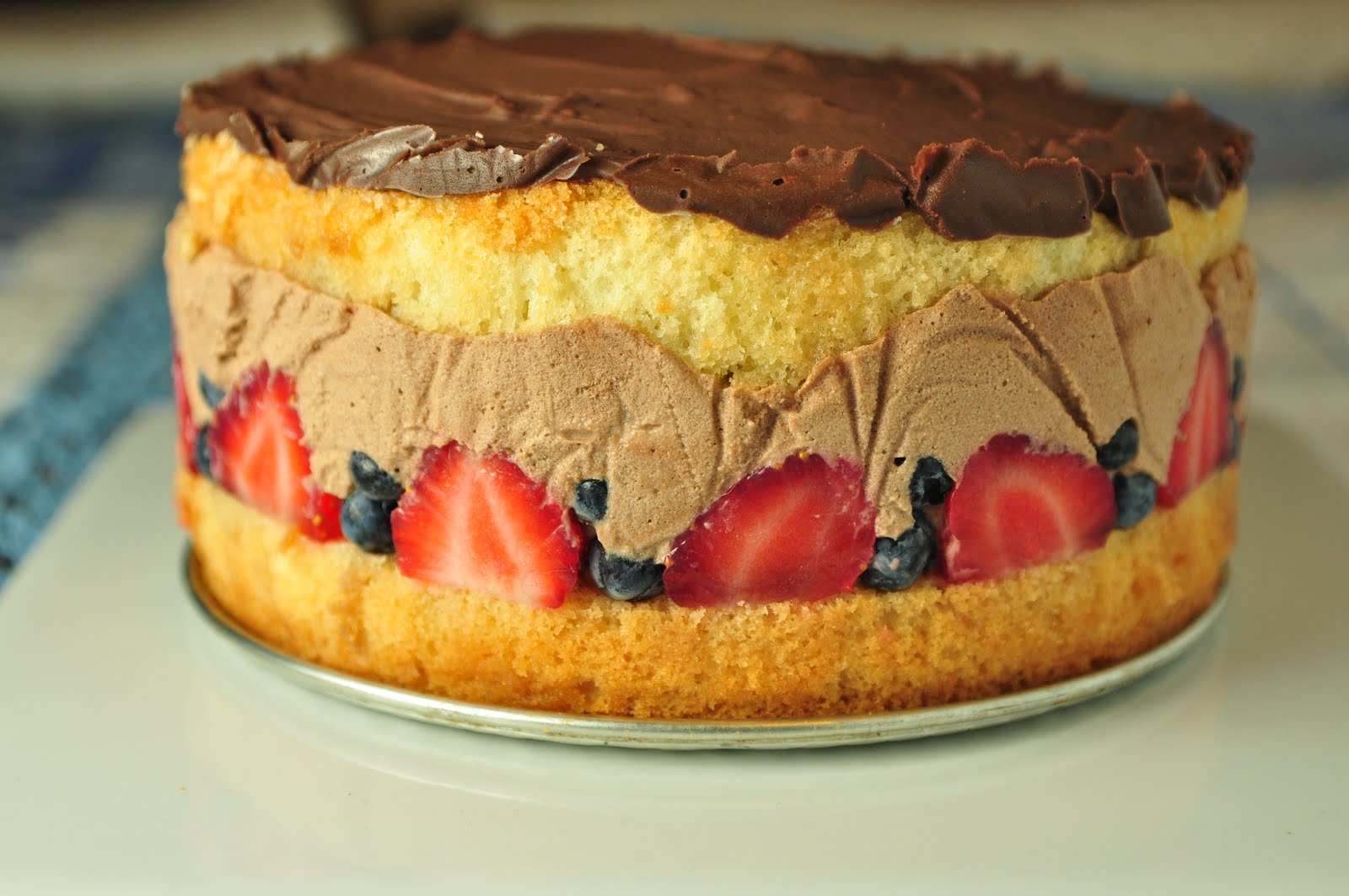
Daring Bakers' July Challenge - Fraisier

Jana of Cherry Tea Cakes was our July Daring Bakers’ host and she challenges us to make Fresh Frasiers inspired by recipes written by Elisabeth M. Prueitt and Chad Robertson in the beautiful cookbook Tartine.

This month’s Daring Bakers’ challenge, fraisier, looked too pretty to be easy – but it was actually fairly straightforward: solidified pastry cream and fresh fruit, sandwiched between two layers of chiffon cake. I loved that this dessert featured fruit, as the season is booming right now.

I really liked the chiffon cake, which came out moist and extremely light. I wanted to make a lemon-flavoured version, but found out halfway through the mixing that I was out of lemons (which almost never happens). So, to add at least one personal touch, I made a chocolate filling.

I know, I know: I’m incredibly predictable. I put chocolate in everything. Even in the dead of summer, when chocolate is one of the least appropriate of all the flavours out there, I have to use it. I simply can’t help myself. Sure, I thought about using cardamom, or orange blossom – but no, it was chocolate that won out. In my defence, the resulting pastry cream was still quite light, and not too sweet.


I bought some beautiful strawberries from Île d’Orléans, as well as some wild blueberries, and raspberries. I had to use a slightly smaller mould than indicated in the recipe, so my cake was rather too high to be cut into two layers. So I cut out three layers, used two for the fraisier, then cut out smaller rounds out of the third layer, to make an individual-sized version with raspberries – I guess you could call it a “framboisier”?

I imbibed the cake layers with diluted maple syrup, instead of simple syrup. Finally, I iced the top of the larger fraisier with dark chocolate ganache, left over from making the chocolate pastry cream.

I have to say, this was a pretty ideal summer dessert: light, refreshing, and pretty as a picture (or, at least, it could have been, if my plastic wrap hadn’t left marks all over the filling). My thanks to Jana for challenging us to make this classic treat!


Please check out the Daring Kitchen to look at the challenge recipes, and don’t forget to look through the blog roll, to see some lovely fraisiers!

Saturday, July 2, 2011

Joanne Fluke's Devil's Food Cake Murder - Raspberry Vinegar Cookies

I don’t browse in bookstores much these days. When I visit Renaud-Bray, or Indigo, I usually have a pretty good idea of what I’m looking for. The truth is, my to-read pile is towering high enough as it is, no need to add serendipity to the mix!

The exception is cookbooks, because browsing is just part of the process of discovering good recipes – and also because it’s hard for me to resist the cookbook aisle. But there’s another context in which I allow myself to browse through books: the airport.

I always pack a book when I leave on a trip. Because iPods can malfunction, and Nintendo DS consoles can run out of juice, but it’s pretty hard to get into a situation where you can’t crack open a good novel (although I do remember a nocturnal transatlantic flight where neither the TV screens nor the reading lights were working, and they wouldn’t leave the main lights on because some people wanted to sleep – that was a long nine hours). But I’m always afraid of running out of reading material, and there’s not a whole lot to do in airports, so I always wind up spending a lot of time at the bookstore. They don’t have a lot of choices, and most of their books are either trendy or lowbrow, but it gets me to look at books that I normally don’t even glance at.

Another recent trend in my reading habits is that I am irresistibly attracted to any book that has to do with food. I’m not talking about factual books: I do pick some of those up on occasion (why wouldn’t I want to learn all about the history of salt?), but I know a lifetime wouldn’t be enough to read everything that’s out there. No, I’m talking about fiction that revolves around food. It’s gotten to the point where I snatch up anything that has a food-related word in the title. In The Kitchen, The Particular Sadness of Lemon Cake, Le cuisinier – it’s all good. Sometimes, the book ends up not being much about food after all, but it's always interesting to see where food does factor in.

It’s not always great literature, of course. But I’m a versatile reader, and I like a little bit of everything in small doses, so I’m usually content, even if I have yet to have my mind blown. Recently, however, I read a food novel that reassured me that I still have standards: Joanne Fluke’s Devil’s Food Cake Murder.


I picked this one up at, you guessed it, the airport. At first glance, it looked right up my alley: a young female baker who solves crime on the side, how could I go wrong? The main character even has a mischievous and demanding cat, something I can definitely relate to. But in the end, I was disappointed.

Of course, one needs to keep in mind that this is part of a long-running series, with recurring characters and themes. So, not having read any of the previous books, it’s understandable that I had a little difficulty relating to the giant cast of characters, most of whom were introduced without any major description or development, with the assumption that the reader was already familiar with them. Fair enough, but a good book should be able work around this problem, and involve new readers even in the middle of a series.

Worse than any format-related issues, however, was the fact that the style was mostly flat, the vocabulary unimaginative. See for example the heroine’s account of an awkward scene with her beau: “He left a couple of messages, but he sounded… […] cold. He sounded cold like he was talking to a stranger. And when he came back he was cold, too. He gave me a hug and thanked me for keeping [his cat], but… he was cold. I don’t know any other way to describe it.” Evidently not. Of course, I’m aware that this is a light series, not a Virginia Woolf novel: it’s meant to be read casually, not dissected. But fun books can be well-written, too – or at least use synonyms.

The crime story itself was decently entertaining, albeit not without its plot holes – but I’ll give that a pass, as I’m pretty sure the sleuth aspect is not supposed to be the main focus of this series. But there were some seriously awkward moments in the dialogue, which, along with the stylistic problems, made me keep a sceptical distance from everything – and I’m usually a pretty immersed reader. Some conversations felt like filler, more than anything else. I think the worst moment, for me, was a character’s reaction to a murder by shooting: “He was shot? […] Oh, dear! That’s just awful! I wish he’d been stabbed, or bludgeoned, or smothered, or something.” This insensitive response is followed by a page-and-a-half long rant where the character expresses her fears that politicians will use this incident to enforce gun control in their state, and goes on to enthusiastically explain why guns are both fun and useful. Regardless of anyone’s personal stance on the issue, that just came out of nowhere, and was in poor taste to say the least.


Okay, but what about the food? After all, it was the food theme that initially drew me to this book. Well, the good news is, there’s a lot of it in this book, and not just sweet stuff: in addition to the devil’s food cake mentioned in the title, you’ll find cookies, bars, soup, brisket, and even a special cake for cats (which looks so incredibly rich that I would never dream of giving even a teaspoon of the stuff to my kitty Paprika). People eat so much in this book, it’s amazing they don’t all have waistlines a yard wide (maybe they do, but with the lack of description, how am I to know?). But there isn’t much in the way of food description: dishes are succinctly described as “wonderful,” absolutely perfect,” or “delicious.” Not quite enough to get my mouth watering.

There are, however, recipes included for nearly all the treats and dishes mentioned in the book, which gives us a little more insight into how all these “delicious” morsels actually taste. Most are intended for novice bakers and cooks, with very detailed instructions and easy-to-find ingredients. One recipe in particular caught my eye, but more because of the title ingredient than because of the characters’ reaction to it: raspberry vinegar cookies. I was curious as to how these could possibly taste good, so of course I had to try making them.

In the end, the vinegar wasn’t a flavour factor at all: its role was just to interact with the baking soda and create a chemical reaction, leading to a particularly light, aerated cookie. Maybe I was heavy-handed with it, because my cookies came out especially brittle, whereas they were supposed to be more similar to shortbread in texture. Regardless, I really liked these cookies (infinitely more than I liked the book), and they seemed to please people when I brought them to a meeting. The only downside to their brittleness was that everyone ended up with crumbs on their shirts…

I haven’t changed much to the original recipe, just added more pecans, and made the cookies a little bigger.


Raspberry Vinegar Cookies
Slightly adapted from Johanne Fluke’s Devil’s Food Cake Murder

Yields 3 dozen

200g (1 cup) butter, softened
190g (1 cup) sugar
1 tsp raspberry vinegar
1 tsp baking soda
1 tsp rum extract
210g (1 1/2 cup) flour
375 ml (1 1/2 cup) chopped toasted pecans

Preheat oven to 160ºC (325ºF).

Cream the butter with the sugar. Mix in the vinegar and the baking soda, then the rum extract. Add the flour, and stir until well incorporated.

Line four baking sheets with parchment paper. Drop tablespoonfuls of cookie dough onto the sheets, spacing them out (about 9 cookies per sheet).

Bake the cookies in batches for around 20 minutes, until golden around the edges and on top. Let cool on sheets for two minutes, then transfer the cookies to a wire rack and cool completely.

Store in an airtight container.