Tuesday, January 24, 2012

Happy Chinese New Year / Têt / Oshogatsu / *insert other appellations* everyone!

Happy Year of the Dragon to everyone!

I've been trying to figure out if I know any dragons, but apart from a distant cousin or two, I can't think of one. The only dragons I regularly encounter are the ones I slay in Skyrim these days (some of which are, incomprehensibly, easier to kill than frost trolls, and even some types of bandits).

I can hear you: "Why are you rambling about a video game, this is a food blog! Where's the food?!" Well, I did make food. Because, as much as I generally dislike regular New Year (I don't know why, I can never completely get in the spirit of it, maybe because Christmas is so much better), I love Têt. Not that we ever celebrated it in a huge way. I actually have a fairly large number of Vietnamese and half-Vietnamese relatives, but they're scattered all over the world, so I've never gathered around a food-laden table with them. I can't recall my mother ever making traditional dishes for the occasion, although I'm sure she made a special effort on that day. Regardless, I just like it.

Of course, with just the two of us, making a whole array of dishes isn't really an option, and Têt crept up on me this year, so there was no time to put a crowd together. So, last night, I just made Vietnamese caramelized ribs, and Japanese shiruko (sweet azuki bean soup).

"What, no pictures? No recipe?" Sorry, not this time. I'd made the ribs before, but this time they came out too salty and very unphotogenic, albeit still good. The shiruko was fine, but desperately needs some fine-tuning, and looked too watery. So, call me picky, but they were not blog-worthy.

I'll be back with a real post later. I just wanted to highlight the New Year and wish a lot of happiness and joy to all of you!

Wednesday, January 18, 2012

The Honeymoon, pt.2 - Prune


And now we come back to our not-so-recent-anymore trip to New York. As mentioned previously, I didn't have a lot of restaurants on my list of destinations, so a lot of the time we just drifted along and stepped in whatever place looked good; after all, there is no shortage of restaurants in NY. But there was one place, apart from Momofuku, that I absolutely wanted to visit: Prune.


It started, as it often does for me, with a book. Having read stratospheric praise for Gabrielle Hamilton's memoir Blood, Bones, & Butter, I bought it soon after if came out. I’ll review it in my next post, but for now, suffice it to say that I absolutely loved it. I was dying to know what kind of food was made by the woman who had written this book. So, the day after we arrived in NYC, I dragged Laurent to the East Village for lunch, where we got lost and wandered around for a while before finally locating the tiny restaurant. As we examined the bright room, with its fuschia barstools and old mirrors, I couldn’t help but think of Hamilton’s description of the place when she first saw it: abandoned, cockroach-infested, covered in rat droppings, and packed with rotting food. I promptly put the passage out of my mind, as the place bore no remaining trace of its former filth, and who wants to be thinking about rat poop right before a meal?


I want to take a minute here to describe my state of mind on that first visit. It was a warm, sunny October day. There was a light breeze. I was wearing my favourite black polka dot skirt, the one that swishes around my legs in a way that makes me feel like a girl. And I was just married, and honeymooning in one of my favourite cities in the world. Most likely all these wonderful things influenced how I perceived my meal. But I’m thinking the food had something to do with it, too.


I confess, I didn’t even take pictures that first time. I didn’t feel like being a food blogger, I just wanted to enjoy myself. Descriptions of the dishes probably won’t do them justice, because they were so very simple. For starters, we split a half-avocado filled with olive oil and sprinkled with Maldon salt. Was it something anyone could have whipped up at home? Sure. But the avocado was perfectly ripe, and the olive oil was fragrant. Next, I had a shaved celery salad with a thick slice of blue cheese on the side, while Laurent had a coddled egg with wild mushrooms. Again, nothing fancy. But everything was just right, from my salad’s vinaigrette to the texture of Laurent’s egg. I could feel the love in the food, and that’s not something that happens very often.


We ended up coming back for lunch again a few days later. This time, we took pictures. Also, we were hungrier, so we ordered more food. We started with a chicken noodle soup with cracklings and matzo balls, which was fragrant and warming.


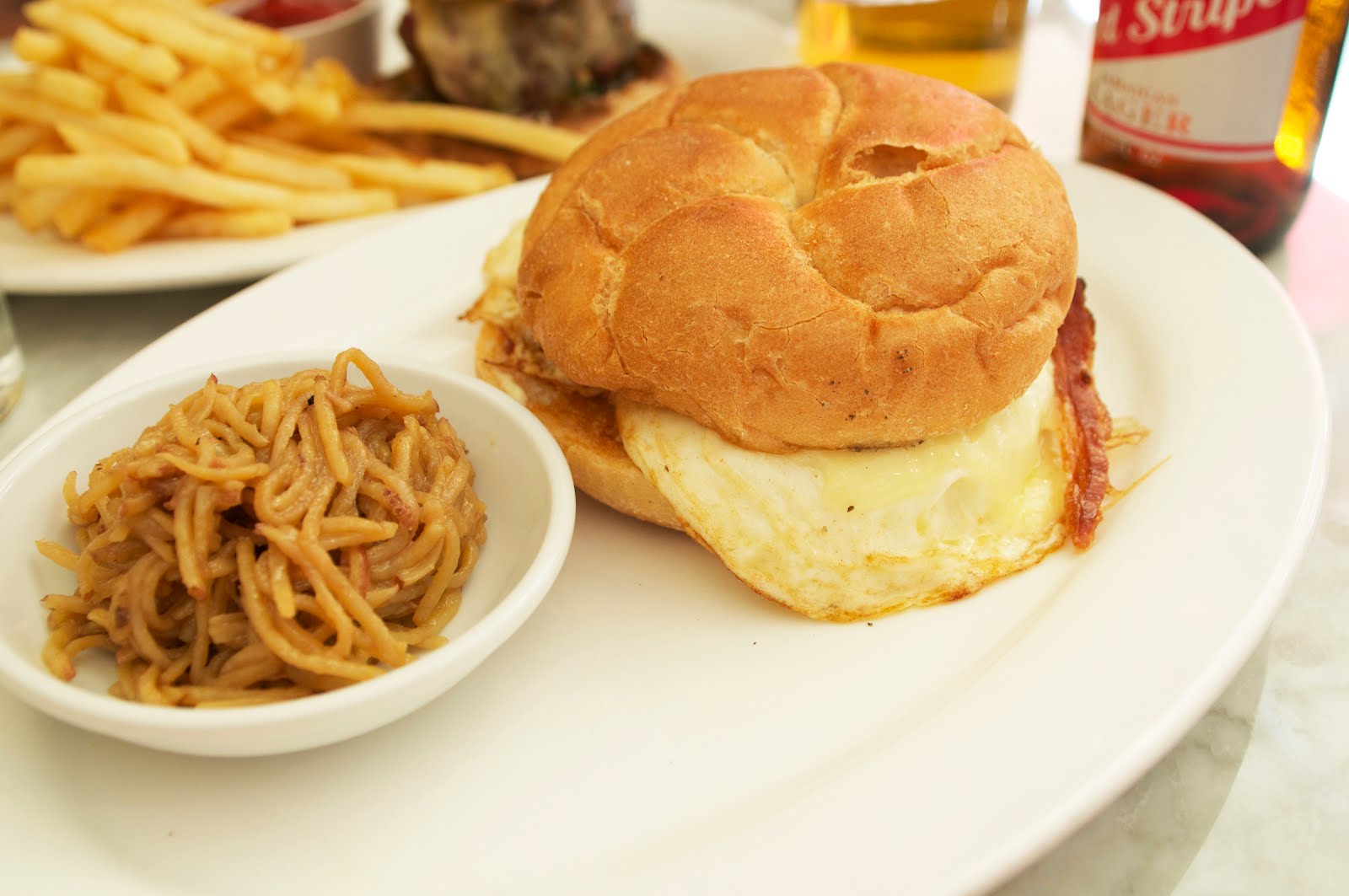
Next, I couldn’t resist ordering something which is mentioned in Hamilton’s book: an egg-on-a-roll. Apparently, she lived on these during her early years in the city, and I myself have eaten my share of these classic deli sandwiches. With crispy bacon, runny yolks, and a side of cold noodles, it was pure comfort food.


Laurent had a burger and fries. The meat was cooked rare, as requested, and was satisfyingly juicy.


Finally, we splurged on dessert: a poached peach with caramelized pecans and crème anglaise for Laurent, and fresh figs with lemon cream for me. Both were light and nicely cleansed our palates, but Laurent’s choice won, I have to admit.


Was this a pure act of fangirlism? Probably. Then again, so was our trip to Momofuku. But in both cases, the quality of the food spoke for itself, despite the absence of frills. Sometimes, you have to put cynicism aside and just recognize that there are cases where a good reputation is well deserved.

Saturday, January 14, 2012

Daring Cooks' January Challenge - Tamales

Maranda of Jolts & Jollies was our January 2012 Daring Cooks hostess with the mostess! Maranda challenged us to make traditional Mexican Tamales as our first challenge of the year!

You may have noticed I skipped out on the last couple of Daring Kitchen challenges. Up until then, I had only skipped one challenge (the croquembouche one, which I still intend to make someday). But toward the end of 2011, there was just too much going on, and I was barely cooking at all. However, with the new year, I was ready to get back on track and get back to the kitchen.

I’ll just announce is right now so that you won’t be shocked when you get to the end of this post: it was a disaster.

I love Mexican food, but had never eaten, let alone made tamales. I wasn’t even sure what they were. Basically, they consist of a filling wrapped inside a corn flour dough, which is itself wrapped inside a rehydrated corn husk, then steamed. Sounded easy enough.


Up until two weeks ago, I had a pack of corn husks in my pantry, purchased on a whim at a Mexican grocery store, in one of those “Oooh, I wonder what I could do with this?” moments. They had lingered there for months, until I was seized by a rabid need to clean up the clutter that had seemingly taken over every shelf, cupboard, and drawer of the apartment, and began moving stuff around and clearing out spaces. In my enthusiasm, I chucked out the corn husks, in one of those “The hell with it, I’m never going to use this” moments. It figures that this month’s challenge called for corn husks.

Too lazy to go out and buy a new package, I decided to use parchment paper instead. In that same spirit of laziness, I opted for the proposed vegan filling, even though I made the very non-vegan lard-infused dough. Assembling the tamales was easy enough, and I used my Asian bamboo baskets for the steaming.

But when the tamales were cooked, I tasted a tiny piece of the dough, and decided I didn’t care for it much. Something about the texture, the way it came apart, and also something about the flavour... Keep in mind that I had never had tamales before, and therefore had no reference. I only knew that I wasn’t wild about what I had made. While doing some research (even when I’m lazy, I still do research, because I am a flaming geek), I found that some people liked to reheat their tamales by frying them. In my book, frying makes everything better, and crispy seemed like a better option than the crumbly, wet-yet-dry texture I had obtained. Into the oiled skillet they went.

Having lovingly stacked and photographed the tamales, Laurent and I dug in. Then stopped. Then looked at each other.

“I’ll make us something else,” I said matter-of-factly, and got up to look for those homemade gyoza I knew were in the freezer.

I now knew what the problem was. It wasn’t the recipe, it wasn’t even my technique. My masa (corn) mix had gone bad. It gave off that horrible stale, bitter, rancid aftertaste. It’s strange, because I made corn tortillas not that long ago, and they were fine; it’s hard to imagine the mix could have gone so bad so quickly. I should have noticed it while making the dough, the smell should have tipped me off. For some reason, it hadn’t. At the very least, I should have noticed it when tasting the dough right out of the steamer, but maybe the steam had temporarily masked the taste. Or maybe I was just distracted.

While I was cooking the gyoza, Laurent had fun salvaging the filling by picking it out of the tamales. He even took pictures.


So, not a particularly glorious start to the year. Obviously, this was completely my fault. But I think I’m going to order tamales from a restaurant before attempting to make them again. And, obviously, I’m going to buy a new bag of masa mix.

My thanks to Maranda for a great challenge idea, and my apologies for screwing it up so badly. If you want to look at real tamales, please look at the Daring Cooks’ blog roll. And if you want to make your own, check out the challenge recipes. Just make sure your masa mix is fresh.


Thursday, January 5, 2012

Happy New Year - Schmaltz, Gribenes, and Almost Kosher Chowder

Happy New Year to you all! I hope you celebrated to your heart's content! Me, well... We were supposed to go out into the countryside, like last year, but I got sick. Nothing serious, but I was not up to frolicking in the snow, or even driving over to the chalet. So we just stayed in, and Laurent made us cacio e pepe spaghetti for dinner - not quite typical for a New Year's feast, but it was exactly the comfort food I needed.

My cold took a long time to heal, but yesterday I was finally up to cooking. Again, I veered toward comfort food, and made chowder. However, once again, it wasn't quite traditional.

I call this chowder "almost kosher" because it contains no pork. It does, however, contain dairy and chicken, so the title of fully kosher is out the window. But that doesn't really matter, since there is not an ounce of Jewish blood in me. So why did I substitute the pork? Simply because I had a lot of schmaltz to use.


(One needs to be very careful when opening what looks like a jar of jam in our house, because they usually contain something else.)

Why did I have schmaltz on hand? Well, it all started several month's ago, when I read David Sax's Save the Deli. I'll post more extensively about this book later, but suffice it to say the author went on a North American tour of Jewish delis, ate a heck of a lot of pastrami and chicken soup, and schmaltz is inevitably mentioned on every other page. Schmaltz, you're probably aware, is rendered chicken fat, and can replace most oils and fats in cooking. I was intrigued by how this influenced the taste of preparations; duck fat makes a big difference, so what of schmaltz?

Unfortunately, I had no idea where to find schmaltz. But since we were already regularly buying whole chickens, boning them, and saving the carcasses to make stock, I took it one step further, and started putting aside all the chicken skin and fat, and saving it in a Ziploc bag in the freezer. Then, when the bag was full, and I had over three pounds of fatty scraps, I rendered it, using the method indicated in Jennifer MacLagan's Fat. Thus, I ended up with two full cups of beautiful schmaltz, and a cup full of gribenes, which are basically chicken cracklings: the crispy bits of skin left over from the rendering process. I usually don't eat the skin off roast chicken, but this was something else: so crispy and delicious! We put them in soups, salads, and even just nibbled on them.

So, the gribenes were easy to dispose of, but for some reason we've been slow to use the schmaltz. Like I said, it can replace butter in most recipes, but we were so overloaded with leftovers (ours and other people's) that we didn't cook for several days. And when we did, they weren't really the kind of recipes where the substitution would be made.


So when I decided to make chowder, I was determined to use the stuff. I drew inspiration from a recipe by Jamie Oliver, but used schmaltz instead of pork fat, and the remaining gribenes instead of bacon. I also adapted the broth-to-dairy ratio. Obviously fresh corn would have been best, but in this season, canned corn had to do. And I used Nordic shrimp, for a local touch.

There was definitely a subtle difference in flavour: less smoky than if I had used bacon, but still more gamey than if I had used butter. I wouldn't say any version is flat-out better than the others, but it's nice to have options. Either way, this soup is a very flavourful and easy meal for a lazy weekday.


Schmaltz and Gribenes

450 g (1 pound) or more of chicken fat and skin

Cut the chicken skin in small pieces. Place them in a heavy-bottomed pan over low heat, and let the fat melt, stirring occasionally, until the skin begins to grow crispy. This can take several hours (between two and four).

Alternately, if you are rendering a large amount of fat, put the chicken skin in a Dutch oven and place in an oven preheated to 120ºC (250ºF). Bake until skin begins to grow crispy, which will take several hours.

In both cases, when the skin is just getting crispy and brown, drain out the rendered fat and strain it through a cheesecloth into a heatproof container. Return the skin to the pan and cook over medium low heat until it is very crispy golden brown. Strain the remaining fat through the cheesecloth, and place the skin on paper towels to absorb the fat.

Store the schmaltz in a clean airtight container in the fridge for up to two weeks. Store the gribenes similarly, and consume them within a couple of days. You should obtain approximately 1 cup of schmaltz for every pound (450g) of chicken skin.


Almost Kosher Chowder
Adapted from Jamie Oliver's Food Revolution

Serves 4-6

2 tbsp schmaltz
One leek, cut in half lengthwise and sliced crosswise
450g (1 pound) of potatoes (approximately 3 large), peeled and cubed
500 ml (2 cups) chicken or vegetable broth
500 ml (2 cups) milk
375 ml (1 1/2 cup) canned or frozen corn
225 g (1/2 pound) Nordic shrimp, fresh or frozen and thawed
250 ml (1 cup) heavy cream

For garnish:
Gribenes
Fresh dill
Fresh red chili pepper, seeded and chopped


In a large saucepan, melt the schmaltz over medium heat. Add the leek and potatoes, and cook, stirring often, until leek is soft. Add the broth and milk, along with the shrimp and corn, and simmer for 10 minutes, until potatoes are tender and soup is somewhat thickened. Reduce heat, stir in the cream, and continue cooking until heated through.

Divide in bowls and top with garnish just before serving.

Saturday, December 24, 2011

Merry Christmas! - Orange Lard Cookies

Whoosh! Christmas rather caught me by surprise this year. Maybe it's the lack of snow, but it took me longer than usual to get into the spirit of things. And yet, with just a few hours to go till Christmas Eve officially starts, everything seems to be on track: the tree is trimmed, the gifts are wrapped, and I've got bread baking in the oven.

As usual when we stay in Montreal, we're spending Christmas Eve with Laurent's parents. They always invite quite a crowd over, and there's always a mountain of food, prepared by Laurent's father. This year, however, I wanted to contribute in some way. I thought about something I can make that no one else around me does; and it had to be something appropriate for an Italian Christmas, so Asian food was out. So I settled on bread. Bread isn't an essential part of supper, but I find homemade bread always adds a nice touch.

So I spent part of today making two kinds of bread from my favourite Marcy Goldman book: pull-apart buttery rolls, which I have made before, and buttermilk biscuits. They're almost ready, so perhaps I'll snap a picture and add it to the end of this post.

I haven't done much holiday baking this year. I did make gingerbread men, for the very first time, and am quite pleased with the flavour, although I may have overbaked them a bit. And I made lard cookies.


I'm quite into Jennifer McLagan's cookbooks at the moment. As you may know, she's been specializing in unpopular foods for several years: Bones (or rather, cooking on the bone), Fat, and, most recently, Odd Bits (not just offal, but generally all the parts of the animal people tend to not use anymore). While flipping through Fat, I came upon a recipe for Spanish-style lard cookies, and decided to give it a try. I'd never cooked with lard before, and was even very surprised to discover how available it is, found in the pastry aisle at most supermarkets - too bad, I was already having visions of rendering pork fat.

The cookies were as simple to make as cookies can be. I substituted orange liqueur for brandy, as I don't keep the latter in the house. Honestly, I'd be prepared to be that no one, save an expert baker, would ever guess that these cookies were lard-based: you can't taste it at all. But it apparently gives a unique texture, and while I would have to make a butter version to compare and really determine the difference, I'd describe the ones I made as crispy, but not brittle or hard, and not sandy either. Not sure this description is very useful, but I would definitely make these again.


Oooh, look at that, my bread is ready! The biscuits taste good, but to be honest they're rather unattractive. Oh well. The pull-apart rolls, on the other hand, look fabulous. (Sorry for the saturated pics, I'm in a hurry.)


Merry Christmas and Happy Holidays to everyone!


Orange-flavoured Lard Cookies
Slightly adapted from Jennifer McLagan's Fat

Yields around 20 cookies

125g (4.2 oz, 6/8 cup) all-purpose flour
60g (2 oz, 1/2 cup) almond flour
100g (3.5 oz 1/2 cup) granulated sugar
2 tsp ground cinnamon
Pinch of salt
100g (1/2 cup, 3.5 oz) lard, diced, at room temperature
1 whole egg
Zest of one orange, finely grated
1 tbsp orange liqueur (Cointreau or Triple Sec)
Icing sugar, for dusting


Preheat oven to 180ºC (350ºF). Line baking sheets with parchment paper.

Mix the flour and almond flour together in a mixing bowl, then spread them on a baking sheet in an even layer. Roast them in the over, stirring occasionally, until they are fragrant and just beginning to brown. Remove from the oven and let cool completely.

Lower the oven to 150ºF (300ºF).

Put the cooled flour and almond mixture in a large mixing bowl, stir in the sugar, cinnamon, and salt. Add the lard and work it into the flour mixture with a wooden spoon or dough whisk, to obtain a homogenous mixture.

In a smaller bowl, whisk together the egg, orange zest, and liqueur. Incorporate this mixture into the flour and lard mixture, and stir to obtain a soft dough.

Take tablespoonfuls of dough, form them into balls, and place them on the prepared baking sheets, about 4 cm (1 1/2 inches) apart, and slightly flatten them with the palm of your hand. Bake until firm to the tough and slightly browned on the bottom, about 30 minutes.

Transfer the cookies to a wire rack and cool completely. Dust with icing sugar and store in an airtight container for up to one week.

Tuesday, December 6, 2011

The Honeymoon, pt 1 - Momofuku

Okay, boys and girls, let's get back on track! It's been an emotional and disorienting couple of weeks, as I have been without a computer: my laptop got stolen. I was at a café with my friends and took out my computer to show them my wedding pictures, which I had finally received. Then I put it back in my bag, which was on the floor right next to me. When I got up to leave, my bag was open and the laptop was gone. The amazing thing is that one of my friends was sitting right opposite me, and she didn't see a thing. Apparently this sort of thing happens a lot in the neighbourhood, with professional thieves preying on students. The worst part is, I practically never bring my laptop to work in cafés, there's too much noise and I'm always scared I'm going to spill something on it. It really was rotten luck...

Anyways, after the first twenty minutes of hyperventilating and being paralyzed by the sheer effort of wrapping my mind around what had happened, while my awesome friends took action on my part and talked to the staff and surrounding customers, after a weepy call to Laurent and a trip to the police station to report the theft, after a couple of days of feeling blue, and finally after taking advantage of Black Friday sales to order a new laptop (a fine piece of hardware which I'm typing this on), I started putting the incident behind me. Fortunately, I had backed up most of my important documents (including the wedding pics and my thesis), so there was no big personal loss. The thought of someone going through my data made me feel sick, but I knew the thieves would most likely be interested in the hardware, not my vacations photos or articles on Japanese pop culture...

And then, a few days ago, I got a call from the police informing me my laptop had been found! I'm picking it up tomorrow. Apparently, it's still in one piece, but they haven't tried to open it, so I don't know if the hard drive has already been wiped or not. Fingers crossed... But honestly, given that less than one in ten stolen laptops is recovered, I wasn't expecting mine to ever be found, so I'm happy either way. The good luck has balanced out the bad!

The moral of the story: always report stolen items, you never know.

So, on with our regular programming. Well, not that regular, as today's post is the first part of the Honeymoon Chronicles. Laurent and I couldn't get away for very long, so we decided to just spend a few days in New York. I grew up there, and Laurent has never really visited the city, so I was looking forward to showing him around. We had a wonderful time. I showed him the classics (the view from the Staten Island Ferry, Time Square, etc.), and also some places which were more personal to me (my old school, specific spots in Central Park). Over the course of five days, we pretty much covered the list of places I had compiled in my head.

My list of restaurants, however, was comparatively shorter. I was just a kid when I lived in NY, and fresh from Europe. At the age of five, I was impressed by things like grape juice, deli sandwiches, pizza, hot dogs, and frozen yogurt, most of which I had never tasted. Then we discovered ethnic takeout, especially Indian and Mexican food, which was not really available in Belgium at the time. My parents took me to a few restaurants, but I can't say I recall whether they really were good, or just conveniently close; and anyway, they've probably been closed for years. My parents lived in New York again several years ago, but none of us, myself included, really kept track of the food scene. No particular place stood out in my memory.


Our hotel was conveniently located near a Pain Quotidien, a chain I was familiar with, so Laurent and I often had lunch or breakfast there. It's ironic, because Le Pain Quotidien is actually a Belgian concept, so it kind of felt like eating, say, McDonald's in Tokyo. Except that Le Pain Quotidien is a million times tastier and healthier than McDonald's (and more expensive, unfortunately, but hey, we were on our honeymoon), and the setting is a billion times more attractive, with its wooden hues and cute little spreads. Besides, I have to admit I never feel bad about eating "foreign" food in North America, probably because immigrant cultures are such a huge part of this continent, and hence the concept of "local cuisine" has always seemed a lot looser here than it does in other regions.


Even though I don't really know much about the current New York restaurant scene, there was one place I knew we had to visit: Momofuku Noodle Bar. Back when I was making David Chang's ramen a few months ago, I took the time to read the non-recipe parts of the book, specifically how the restaurant came to be. I liked how things apparently really kicked off when the chefs decided to stop trying to be "authentic" and just started to make whatever they wanted, according to the seasons and their own whims. And the ramen I had whipped up in my kitchen had been really very good, so I could only imagine how great the real thing would be.


If we could get in, that is... I knew the place was hugely popular but not correspondingly huge, and fully expected to find people lined up in front. Which we did. I asked the hostess how long the wait would be for two people, prepared to wait for over an hour if need be (I've done it for Kazu on more than one occasion), and nearly fell over when she answered that she could seat us right away. And smack in the middle of the counter, no less! Luck of the newlyweds!


We started off with some shiitake buns. They were great, with very salty mushrooms, soft steamed buns, and crunch pickles.


But the real treat was watching the cooks prepping bowl after bowl of ramen. These guys were maintaining a serious rhythm!


I ordered the shoyu (soy) ramen, while Laurent ordered a miso version. I knew Chang had recently changed his broth recipe, to make it more environmentally and economically friendly, which I can only applaud; he now makes the broth with only chicken bones, no more pork bones. The result was still very good, with strong umami and smokiness compensating for the lack of meatiness. The noodles were awesome, firm bordering on chewy, as far from limp, sissy noodles as you can get. The pork was tender and deliciously seasoned. But... I have to say this: how I wish I could have tasted the original version! I get that it uses a lot of meat and generates a lot of waste, but I was honestly blown away by what I managed to make myself with the old recipe, and have no doubt the served far superior bowls at Momofuku back then. This new version is definitely great, but the difference is nonetheless felt...


Laurent's miso ramen, however, was spectacular. Neither of us had anything bad to say about it: it was simply perfection, with ideally balanced flavours. It's right up there with the burnt miso ramen we had in Tokyo and have been fantasizing about ever since. Maybe we just have a special weakness for miso... But Jesus, it was good.


So, that was one of the high culinary points of our trip. More to come!

Sunday, November 20, 2011

My kind of bachelorette event - A bread baking class at Mezza Luna

I’m back from the honeymoon! Ok, I’ve actually been back for quite a while now… Getting back into real cooking, after a month of predictable standards and eating out (wedding preparations take up SO much time!), has taken some time, and I’ve been pretty busy with my thesis as well. I’ve even been taking a break from the Daring Kitchen, although I plan to get back into it next month.

Then I realized I have a lot of food-related stuff to write about that doesn’t involve cooking and recipes. I’ve never been an event blogger, and I very, very rarely write reviews about anything, but desperate times call for desperate measures! So let’s try something different for a few posts, to give me some time to build up my stock of recipes and photographs.

If you’re eager to see wedding pictures, you’ll have to wait a bit. We have quite a few pics taken by our guests, but the official photographs will take a little longer to arrive. Besides, before we get to the wedding, we have the bachelorette party to deal with!

My two bridesmaids and I have been friends since we were fifteen. Ironically, I was the one who had moved around the most at the time, and I ended up being the only one to stay in Montreal all this time: both of the others ended up moving out of the country at different times. But we always kept in touch, and one of them eventually came back, while the other visits every now and then, and flew all the way from London just for the wedding.

One thing these longtime friends of mine have probably figured out about me by now, is that I am not really a party girl. I’ve had my clubbing period, but I was never completely comfortable with it, and was mainly tagging along with the other. I’ve always had a lot more fun at house parties, and now that I’m more in the dinner party years (probably a little prematurely, but it suits me just fine), I’m completely in my element.

So I was pretty happy when my friends suggested a daytime bachelorette party. However, I was a little taken aback when they told me to meet them at Jean-Talon Market at nine o’clock in the morning on a Sunday. What on earth were they going to make me do? Give me a grocery list and make me cook them breakfast? Then they told me to bring a bathing suit, so I thought maybe we would be going to a spa.

Well, it turned out the bathing suit was just a red herring, and I wasn’t that far off the mark with my first guess. They didn’t exactly make me cook for them, but the activity involved cooking, more precisely baking: they took me to the Mezza Luna cooking school, run by local chef Elena Faita (mother of cookbook author Stefano Faita), for a bread baking class.


My apologies in advance for the uneven pics, but since I thought we were going to a spa, I hadn’t brought my camera, and the lighting wasn’t good enough for the point-and-shooter my friends had brought.

The class was led by "baker on the go" Marc-André Cyr (sous-chef at Olive + Gourmando), and we covered three kinds of bread: basic white, English muffins, and cranberry-ginger scones. Now, longtime readers might be thinking: “But don’t you already know how to make bread?”. Indeed, but so did most of the other people attending. It’s one thing to read up on bread, and I do believe that bread is one of those things you can only perfect by rolling up your sleeves and just going for it as often as you can. But there are benefits to taking the occasional class, even if it’s only a demonstration. I definitely learned a few things.


My friends pulled some strings (ok, one of them just got up and talked to Elena) and got me an authorization to get up there and touch the dough. I was amazed at how much stickier Marc-André’s dough was compared to the kind I usually end up with (with the exception of Chad Robertson’s bread, where the dough is so wet you can’t properly knead it on a surface and have to keep it in a container). I was also surprised by how gently he handled the dough: I’ve always instinctively put my whole weight into kneading, whereas he just seemed to flip it around. It wasn’t easy, either: when I tried it myself, the dough kept sticking to the counter and tearing. It was mildly humbling, but I left with a pretty good idea of how to improve my breads. I also left with the recipes...


The class included coffee and breakfast. My friends had thoughtfully brought along a bottle of prosecco, which we downed in celebration; after all, nothing says “bachelorette” like getting tipsy before noon. As for the meal itself, it was good to be reminded how crazy good homemade bread still warm from the oven can taste – even better when it’s served with homemade jam and quality capicollo!


I’m actually glad to be posting about this so much later after the event: it gives me a chance to feel grateful all over again for the wonderful day my bridesmaids put together! The fun didn’t end there, but the food-related part does, so… I’ll leave you on that note!