Thursday, August 18, 2011

Food, Culture, and Friends - Matsuri Japon


Okay, Evelyne has put me to shame by posting about this days ago, so… I really need to write this now.

Last weekend, I hung out with two lovely gals and fellow food bloggers: Evelyne of Cheap Ethnic Eatz, whom I’ve seen on several occasions, and Mary of Mary Mary Culinary, who was in town for a few days, and whom I was meeting for the first time. Incidentally, Mary was hosting the August Daring Cooks’ Challenge, the deadline of which was only a day away. Fortunately, I’d completed the challenge the day before, so I could confront her guilt-free. :-)

It turns out there were quite a few things to do in Montreal that day, including Gay Pride-related activities, and Otakuthon, which I actually didn’t remember about until Monday. Not that I would’ve forced my two friends to attend an anime convention… But in the end, we settled for another Japan-themed event: the annual Montreal Matsuri Japon festival.

Every year for the past ten years, Matsuri Japon (a masturi is a traditional Japanese festival) has been celebrating Japanese culture. Despite my interest in the latter, I had never attended the event, and was looking forward to finally seeing it for myself.

Finding the location was easy enough: we just followed the throng of yukata-clad girls. You could actually borrow a yukata on site, and wear it around the festival (sadly, I didn’t have a good pic of people wearing the traditional garment, but you can see some in Evelyne’s post). Japanese dyed fabric, jewellery, stationery, toys, and other trinkets were on sale at various stalls.


Of course, being food bloggers, we were (not solely, but mostly) in it for the food. There was quite a bit to choose from, including prepared bento, curry, and noodles. Mary and Evelyne went for the okonomiyaki.

I never understand why the okonomiyaki is so often described as a “Japanese pizza.” “Japanese pancake” is a comparatively better fit, but anyone looking for the fluffy texture of a pancake will be sorely disappointed. The only way I can really accurately describe okonomiyaki is: pan-fried batter with stuff in it, topped with katsuoboshi (dried bonito shavings), aonori (nori sprinkles), special brown sauce, and mayo (and, ideally, pickled red ginger, or beni shoga). The “stuff” you put in it can vary, but usually includes cabbage and shrimp.

The girls had some trouble eating their okonomiyaki with chopsticks (normally, it should be pre-cut into wedges). Meanwhile, I was happily slurping refreshing hiyashi udon, chilled noodles served in a cold light sauce.


I also splurged on a couple of takoyaki, or octopus balls.


It seems to take quite a bit of time to make takoyaki, and they need to be frequently turned over. I really want that apparatus, though.


All of this was happening against a background of entertainment, including traditional dancing and taiko drums. The latter were really impressive, and the players looked like they were having a real blast.


How cool would it be to have one of these in your living room? I can think of a lot of uses for those mallets, too.


There was also the traditional carrying of the shrine. I kind of like that they didn’t even try to make it look like a real, ancient shrine, and just went for a simple design.


The kids had their own shrine (as happens in real matsuri), and they also performed on the drums (I have pics, but they’re sub-par).


I don’t think all matsuri have a dragon, but it never hurts to have one.


It was a very fun event, and it was even better sharing it with my foodie friends. Thanks for a great afternoon, girls!

Sunday, August 14, 2011

Daring Cooks' August Challenge - Appams and Curry


Mary, who writes the delicious blog, Mary Mary Culinary was our August Daring Cooks’ host. Mary chose to show us how delicious South Indian cuisine is! She challenged us to make Appam and another South Indian/Sri Lankan dish to go with the warm flat bread.

This month’s hostess’ blog is one of my regular and favourite hang-outs, so I couldn’t wait to find out what she had planned for us. Mary didn’t disappoint.


I’ve made naan bread many times, and I’ve also had the unleavened bread chapatti in Indian restaurants, but appams were entirely new to me. They are basically yeasted pancakes, except that they are egg-free. And made from ground rice instead of wheat flour. And shaped more like a crêpe.

There was a lot of resting time, but overall the preparation was mostly similar to pancakes or crêpes. And, since I can almost never manage to make perfectly round crêpes, there’s no reason why I should have expected to be able to make perfectly round appams.


The appams tasted very mild, and I loved their light, slightly spongy texture.

As a main dish, I chose the chemeen pappas, or shrimp in coconut milk. I thought I had all the necessary ingredients on hand, but then realized I had no curry leaves. I searched and searched my (admittedly very cluttered) pantry, but couldn’t find any. I ended up using dried basil instead – not a substitute by any means, but the result was surprisingly palatable.


The shrimp were great, spicy with just the right amount of heat, and a great sauce that was just begging to be mopped up with the appams – and naturally, we obliged.

Thank you, Mary, for this instructive challenge! The rest of you, please check out the challenge recipes at the Daring Kitchen, and click through the Daring Cooks’ blog roll to see the tasty dishes served this month!

Wednesday, August 3, 2011

Totally Worth It - Momofuku Ramen (or close enough)


I promised you a post about ramen. This is it.

It all started when I found out about a Food Film Festival at Cinéma du Parc. I immediately bought tickets for a few select films. Among them was Delicatessen, about which I seriously wonder why it was included in this festival: it’s barely about food at all, although I suppose cannibalism is a type of gastronomy (and no, there was nothing about cannibalism in the synopsis, which makes the movie sound like a cutesie rom com - which, I assure you, it is not). We also saw Kings of Pastry, a documentary about pastry chefs taking the Meilleur Ouvrier de France exam. We witnessed some spectacular displays of sugar-pulling and sculpting skills – and some really nerve-racking brushes with catastrophe. It really makes you marvel at what people will put themselves through for their passion. There were also films I’d already seen, such as Chocolat and the exquisite Babette's Feast.

But my favourite discovery was Tampopo. I’d heard of it, and jumped at the chance to see it. It’s mainly about a woman who owns a ramen shop and is on a quest to make the best bowl of noodles ever. She enlists the help of a gruff trucker who really knows his way around a ramen kitchen, and other experts join along the way. But more than a film about ramen, Tampopo is a film about food and people who love food. There are various, seemingly random scenes inserted in the film focusing on anonymous characters and their relationship with food. Many of these scenes are absolute gold. This is one of my personal favourites. It's in Japanese, but basically the women are trying to learn how to eat pasta the "Western" way, without making any slurping noises, and... Well, see for yourself.

Ramen are still a major part of this film, though. The secret ingredients in the broth, the ideal resting time for the noodle dough, the ideal thickness of pork slices: everything is important. Even the way you eat your ramen is important. And here, I can’t resist linking to one of the film’s opening scenes, which addresses just this very question (and this one has subtitles).

I walked out of there with not much more than a vague idea of how to actually make good ramen (except that one must never let the soup boil – which I already knew from making pho), but a very strong desire to tackle this seemingly monumental task. So, I did some research. I came across a lot of recipes about how to make good broth and cook pork, but all of them used either dried noodles, or homemade egg noodles – and from what I understood, ramen noodles are supposed to be egg free (more on that in a minute). I read some good advice on the Chowhound forums, and some great posts on the blog No Recipes. And then, I discovered that David Chang’s Momofuku cookbook includes everything you need to know to make ramen from scratch. I found the book, flipped through it, drooled at nearly all the recipes, and took it home.

I lived in New York from 1988 to 1994, and my parents lived there again from 2003 to 2006. I visited them a lot during the latter period, but even though Momofuku Noodle Bar was already well known at the time, I never went there (I wasn’t nearly as interested in food as I am today). Having read the cookbook, this place is now on my list of musts for my next trip to NYC. The recipes seem full of bold flavours and unusual combinations, without a hint of pretension.

But my first concern was the ramen. The process was even more daunting than I’d expected. The first task was to make taré, which is described as “Japanese barbecue sauce.” Upon reading the ingredients, I realized this was basically what I and most people I know refer to as teriyaki sauce, only more complex: in addition to soy sauce, sugar, and mirin, this reduction had to include fond de volaille, made from roasting chicken bones. Ever since I learned to bone chickens, I’ve been buying whole birds and saving the carcasses to make stock, and I just happened to have one in the freezer. I’d never made fond before, and wasn’t too happy with the small quantity I ended up with. I’m not sure it made much of a difference in my taré.

The broth was next, an elaborate process of simmering chicken, dried and fresh vegetables, bacon, and pork bones for a combined total length of over eight – yes, eight – hours. I wasn’t sure I would be able to find pork bones: I was told most butchers probably wouldn’t have them on hand, because Western cooking usually revolves around stocks made with chicken and beef bones, and fond made from veal bones. Thank heavens for Asian supermarkets! I went to Marché Fu Tai and got some awesome-looking pork bones (leg and neck, from the looks of it), which the butcher sawed into segments for me. After the full eight hours, the stock was truly a thing of beauty: rich and fragrant, and as it cooled it turned into a gelatinous marvel. I seasoned it with the taré, following David Chang’s advice to keep flavouring until it’s “not quite too salty but almost.”


Chang uses two kinds of pork in his ramen, but I decided to skip the shredded shoulder and stuck to classic sliced pork belly. When I asked for pork belly at a butcher shop at Jean-Talon Market, the woman behind the counter apologetically said she only had a big, 4-pound slab, which was vacuum-packed and therefore couldn’t be divided. I lit up and told her that was perfect. The pork was rubbed with salt and sugar, then baked at high, then low temperatures (Chang writes that this method was born out of a mistake, but the result was so good he decided to keep doing it). It was mouth-wateringly tender and flavourful, and the leftovers were used for banh mi sandwiches.

And finally, there were the noodles. That was the part that had me most worried. I’d done research, and had learned that ramen noodles, contrary to what one may think, don’t contain eggs: they get their yellow colour from kansui, or alkaline water. Kansui also speeds up the production of gluten, and makes the noodles firmer. I found a comment on Chowhound that someone had managed to locate some of this hard-to-find liquid near Jean-Talon. I looked around and found some at Thai Hour. (On a side note, I was reminded never to judge a store by appearances: my first instinct was to check Marché Oriental, which is also in that neighbourhood. It’s the larger and better-lit of the two stores, so I thought I had a better chance. But no, I found the kansui across the street, at the much more modest-looking Thai Hour.)

I was tempted to hand-pull the noodles, as I had seen it done in the Oishinbo volume on ramen and gyoza (Oishinbo is an amazing manga about Japanese cuisine, which I have previously mentioned). The process just looks so bad-ass and impressive (this is unflipped manga, so read the panels right-to-left):


But I decided to save that experiment for another time, and just used the pasta roller, which is how Chang does it anyway. Incidentally, he commented on his own recipe by saying that the home cook didn’t really need to go to the trouble of looking for kansui, or even making noodles from scratch. But when people give me leeway in a recipe, I take it as a challenge to refuse said leeway. :-)

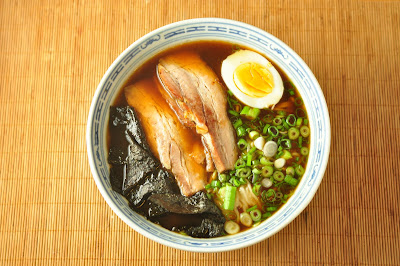
Okay, with all that done (it took about two days and a half), all that was left to prepare were the other toppings. Traditionally, ramen is topped with pork belly, half a hard-boiled egg, squares of nori, menma (softened bamboo shoots), scallions, and naruto (sliced fish cake). Naruto is usually storebought, and I knew where to buy some, but I could only get it in a relatively large chunk. Since I would only need a little bit, and have no use for this ingredient outside of ramen, the rest would have gone to waste. Besides, naruto doesn’t taste like much (although it does give ramen their distinctive “look”), so I had no qualms about skipping it. I also skipped the menma, mostly because I was tired of cooking and just wanted to eat the damn soup already.


I had to be reminded of how to boil an egg while avoiding that ugly grey ring around the yolk: put the egg in cold water, bring to a boil, turn off the heat, and let sit for 10 minutes, 8 minutes if you want the yolk to be ever so slightly creamy. (Chang tops his ramen with slow-poached eggs, which I also know how to make, but as I explained, I was kind of in a hurry to eat.)

It’s important for the broth to be hot when you ladle it, and the bowls should ideally be warmed in a low-temperature oven. The water for cooking the noodles should be simmering, not rolling: a full boil can strip away some of the flavour (Mind you, I haven’t tested this theory for myself, but that’s what Oishinbo says… Seriously, there’s a whole chapter about this). The cooking time varies depending on the noodles.

So, was it worth it? Oh hell, yes! It tasted out of this world. No, actually, it tasted like Japan, and took us right back to those narrow little ramen shops in Tokyo. The broth was amazing, the pork melted in our mouths… The noodles could have been more toothsome, but I’d had to improvise on them: the recipe called for alkaline salts, and all I had was alkaline water, so I had to guess the amount, and probably should have added a tiny bit more. But you can bet I’m going to keep tweaking this until I get it right.


So, that was my first foray into homemade ramen. I can’t wait to make more, and try other kinds of broths, especially miso. I faithfully followed the recipe for my first attempt, but now that I have a pretty food idea of the process, I want to come up with my own recipe, my own ideal ramen. Yummy days ahead!

Wednesday, July 27, 2011

Daring Bakers' July Challenge - Fraisier

Jana of Cherry Tea Cakes was our July Daring Bakers’ host and she challenges us to make Fresh Frasiers inspired by recipes written by Elisabeth M. Prueitt and Chad Robertson in the beautiful cookbook Tartine.

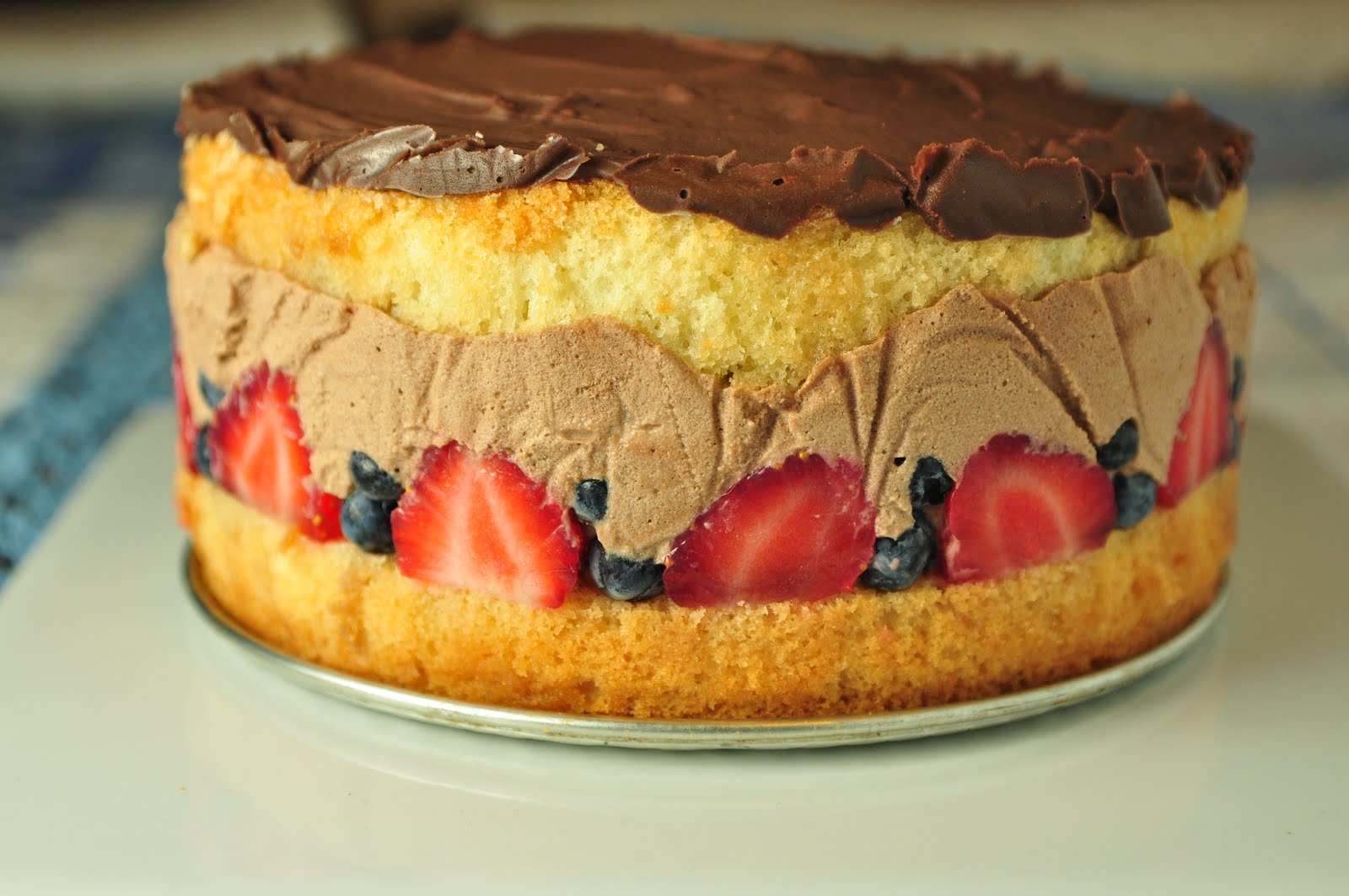
This month’s Daring Bakers’ challenge, fraisier, looked too pretty to be easy – but it was actually fairly straightforward: solidified pastry cream and fresh fruit, sandwiched between two layers of chiffon cake. I loved that this dessert featured fruit, as the season is booming right now.

I really liked the chiffon cake, which came out moist and extremely light. I wanted to make a lemon-flavoured version, but found out halfway through the mixing that I was out of lemons (which almost never happens). So, to add at least one personal touch, I made a chocolate filling.

I know, I know: I’m incredibly predictable. I put chocolate in everything. Even in the dead of summer, when chocolate is one of the least appropriate of all the flavours out there, I have to use it. I simply can’t help myself. Sure, I thought about using cardamom, or orange blossom – but no, it was chocolate that won out. In my defence, the resulting pastry cream was still quite light, and not too sweet.


I bought some beautiful strawberries from Île d’Orléans, as well as some wild blueberries, and raspberries. I had to use a slightly smaller mould than indicated in the recipe, so my cake was rather too high to be cut into two layers. So I cut out three layers, used two for the fraisier, then cut out smaller rounds out of the third layer, to make an individual-sized version with raspberries – I guess you could call it a “framboisier”?

I imbibed the cake layers with diluted maple syrup, instead of simple syrup. Finally, I iced the top of the larger fraisier with dark chocolate ganache, left over from making the chocolate pastry cream.

I have to say, this was a pretty ideal summer dessert: light, refreshing, and pretty as a picture (or, at least, it could have been, if my plastic wrap hadn’t left marks all over the filling). My thanks to Jana for challenging us to make this classic treat!


Please check out the Daring Kitchen to look at the challenge recipes, and don’t forget to look through the blog roll, to see some lovely fraisiers!

Saturday, July 23, 2011

Inspiration from Pop! - Goat Cheese Tart with Olives


I don’t blog much about restaurants here, mostly because I simply don’t consider myself enough of an authority to give an edifying review. Also, all things considered, Laurent and I don’t eat out all that much, just the two of us. We splurge every now and then to celebrate something big: a publication, a successful milestone (although, even for anniversaries, we tend to stay in and cook up our own feast). The rest of the time, when we eat out, it’s usually circumstantial. Sometimes it’s because we’ve both been too busy to cook that day, in which case we step out to one of the many casual places in our area. Most often, it’s because we have to be somewhere right after or before dinner (a movie, or a show), and it’s more convenient to eat in the neighbourhood.

Even then, we tend to return to the same places. And since today’s recipe is inspired by a restaurant, I thought I might as well mention the places we like to go. Around our place, we’ll go for sushi at Atami, a burger or onion soup at McCarold’s, or lemongrass chicken at Le Camélia. If it’s a nice day and we’re in the mood for really good Vietnamese food, we’ll walk all the way to Hoai Huong.

If we have to be downtown (for a movie or an opera), then it’s often Kazu. Yes, we’re part of those crazy people who wait in line on the sidewalk for thirty minutes to an hour (if we can, we try to show up half an hour before they open, since we know we’re going to have to wait at least that long anyway). And yes, we can feel the contempt in passers-by’s eyes, and we hear them whisper “What the hell, that’s just nuts!”, and on some days, when it’s cold or raining, we even start to feel a little ridiculous. But after we finally get a seat at the counter and take that first bite of okonomiyaki or 48-hour-pork, our faith is re-established, and we know without a doubt that this place is worth it. On days when time is too much of a factor, we’ll turn to Ba Le (they’re often out of their delicious homemade bread for their bahn mi sandwiches, but their pho is one of the best I’ve had) or the spiciness of Cuisine Szechuan.

When we have to be near the Plateau, usually to see a play at the Théâtre de Quat’ Sous, we experiment a bit more. Sometimes, out of nostalgia (I used to live in that area), we’ll grab a Portuguese chicken sandwich at Rôtisserie Coco Rico. We’ve tried out Big In Japan, but were disappointed. Recently, we’ve been going to Pop!, the wine bar affiliated with Laloux. We started going there because they used to offer a post-show menu deal, making it the ideal post-show destination (and for nights when we go to Espace Go, Leméac still offers a late night two-course meal at $25 – a real steal!). The deal is now gone, but we keep going back, because the food remains very affordable… and very good. Not to mention, we discovered a few very good wines.


The last time we were there, I had one of their “tartes salées” (savoury tarts), which are basically pizzas (in fact, I just saw that, amusingly, their online menu now refers to them as pizzas). The Marrakesh tart really blew my mind. Topped with goat cheese, olives, honey, and mint, it was both refreshing and hearty. It was so good I took the time to discern every ingredient (which wasn’t too difficult), and jotted them down when I got home, so I could try to recreate the dish. And I did.

I hesitated before posting this, wondering if it was ethically acceptable to copy a restaurant dish (just like I never post someone else’s published recipe if I haven’t adapted it). Normally, I would have tweaked it, but it seemed so perfect as it was, I didn’t feel the need to change anything. But it’s not like I asked for the recipe, and my result is certainly not exactly the same as the original: I’m pretty sure I used too many olives (we were really hungry when I made this), I may have missed a “secret ingredient” or two, and the crust is definitely not as good. But it’s still a decent effort, and I really wanted to share it with you. So, in homage to Pop!, here’s my version of their Marrakesh tart.

You can use any kind of pizza dough you like, although a thicker crust is preferable. I used Marcy Goldman’s Best Pizza Dough Ever, but was pressed for time, so I cut a few corners. It’s a good dough for thicker-crust pizzas. It yields enough dough to make 6 small tarts, but you can freeze any excess dough for future use.


Goat Cheese Tart with Olives
Inspired by the kitchen of Pop! Bar à vin

Yields two individual tarts

Pizza dough (adapted from Marcy Goldman’s A Passion for Baking)
1 3/4 cups warm water
2 tsp instant yeast
2 tsp sea salt
1 tbsp sugar
3 tbsp olive oil
2 cups olive oil
5 to 6 cups bread flour

Garnish
150g (5 oz) soft, fresh goat cheese
1/2 cup green olives, pitted and sliced (preferrably spicy)
1/2 cup Kalamata olives, pitted and sliced
1 tbsp coriander seeds
One handful of fresh mint leaves, coarsely chopped
1/2 tsp dried thyme
Honey, for drizzling
Cracked black pepper, to taste


In a large bowl, whisk together the water and flour. Stir in the salt, sugar, olive oil, and half the flour. Switch to kneading by hand (or use a stand mixer with a dough hook) and gradually add the rest of the flour, until you obtain a smooth, soft, elastic dough (about 15 minutes of kneading by hand). Spray the bowl and dough with oil, cover with plastic wrap, and let rise for 60 minutes.

Gently deflate the dough and cut off one third. Wrap the remaining two-thirds of dough tightly in plastic and freeze for future use. Divide the rest of your dough in two. Take one portion, place it on a lightly floured surface, pat it down with your fingers, and stretch it into a 23 cm (9 inch) disk. Fold the edges under, to make a thicker crust. Repeat with the second portion. Place a few pie weights (or dried beans) over the centers of the tarts, to prevent them from rising too much (Marcy suggests putting the toppings at this point, but I fear this could lead to a soggy dough; and in this case, the toppings really need to be added post-baking). Cover lightly with plastic wrap and let rise for another 45 to 60 minutes, until puffy.

Preheat oven to 240ºC (475ºF). Remove the weights from the dough. If the tarts have risen too much in the center, press them down lightly with your fingers. Place on baking sheets or pizza rounds, and bake for 15-20 minutes, until well browned.

While the tarts are baking, place the coriander seeds in a skillet over high heat, and toast, stirring constantly, until they are fragrant, about 1 minute or 2.

Whisk the goat cheese until smooth and creamy.

When the tarts are baked, garnish them with dollops of cheese, then sprinkle them with sliced olives, coriander seeds, mint leaves, and thyme. Drizzle with honey and season with pepper to taste. Cut into wedges and serve immediately.

Thursday, July 14, 2011

Daring Cooks' July Challenge - Homemade Noodles

Steph from Stephfood was our Daring Cooks‟ July hostess. Steph challenged us to make homemade noodles without the help of a motorized pasta machine. She provided us with recipes for Spätzle and Fresh Egg Pasta as well as a few delicious sauces to pair our noodles with!


This month’s Daring Cooks challenge couldn’t have come at a better time. I had been wanting to make pasta from scratch for a while now, and had already borrowed my father-in-law’s pasta machine even before the challenge was revealed (it also came in handy for the Daring Bakers’ baklava challenge).

I started off simple, by following the egg fettuccine recipe provided. The dough was very easy to work with. When cutting the pasta, the strands initially stuck together, and I had to finish separating them by hand. But I floured the next batches more thoroughly, and there were no other problems. I prepared the fettuccine very simply as well, a variation on aglio e olio: some garlic-infused oil, a crack of pepper, and some baby spinach thrown in with the pasta at the last minute. I would have liked the noodles themselves to be a little slicker, but I guess making pasta takes practice.


After that, I just had to make stuffed pasta: so many possibilities! My father-in-law had lent me a nifty little gadget to help with making ravioli.


Once the pasta is rolled, you place it over the cutters and stuff the pockets.


Cover with another sheet, run a rolling pin over, then turn over and press down.


And voilà! Just cut out the ravioli, and you’re done!

For the filling, I sautéed some finely chopped pancetta and portobello mushrooms, then mixed in some parsley, bread crumbs, and an egg. It wound up being a little too dry, and the sage-infused butter I used as a sauce did little to balance it. Normally, I guess one would have added ricotta, but nobody likes ricotta around here…


Ok, they’re not the most photogenic little morsels, either. Again, practice makes perfect.

I finished off this challenge with the dish I am proudest of: homemade ramen. Actually, I didn’t really think of this as part of the challenge: circumstances last week conspired to fill me with an irresistible urge to make ramen, and I spent four days running around looking for recipes and ingredients (when I get the urge to make something in particular, I tend to get a little obsessed). I didn’t think I would get this done before the deadline, but it turns out I was able to serve it for dinner last night.


I’m actually going to make a separate post about the making of this dish, so I won’t go into details here. I’ll just specify that I didn’t go so far as to pull the noodles by hand, which is the traditional way to make these. Instead, I used the pasta machine. So making the noodles themselves wasn’t much different from making pasta, except that the ramen dough was egg-free, and included a hard-to-find ingredient called kansui, or alkaline water.

This was definitely one of the most productive and inspiring challenges I’ve taken part in. Thank you, Steph! The rest of you can look at the challenge recipes here at the Daring Kitchen, and also go through the Daring Cooks’ blog roll to see what other kind of noodles were cooked up this month.

Saturday, July 2, 2011

Joanne Fluke's Devil's Food Cake Murder - Raspberry Vinegar Cookies

I don’t browse in bookstores much these days. When I visit Renaud-Bray, or Indigo, I usually have a pretty good idea of what I’m looking for. The truth is, my to-read pile is towering high enough as it is, no need to add serendipity to the mix!

The exception is cookbooks, because browsing is just part of the process of discovering good recipes – and also because it’s hard for me to resist the cookbook aisle. But there’s another context in which I allow myself to browse through books: the airport.

I always pack a book when I leave on a trip. Because iPods can malfunction, and Nintendo DS consoles can run out of juice, but it’s pretty hard to get into a situation where you can’t crack open a good novel (although I do remember a nocturnal transatlantic flight where neither the TV screens nor the reading lights were working, and they wouldn’t leave the main lights on because some people wanted to sleep – that was a long nine hours). But I’m always afraid of running out of reading material, and there’s not a whole lot to do in airports, so I always wind up spending a lot of time at the bookstore. They don’t have a lot of choices, and most of their books are either trendy or lowbrow, but it gets me to look at books that I normally don’t even glance at.

Another recent trend in my reading habits is that I am irresistibly attracted to any book that has to do with food. I’m not talking about factual books: I do pick some of those up on occasion (why wouldn’t I want to learn all about the history of salt?), but I know a lifetime wouldn’t be enough to read everything that’s out there. No, I’m talking about fiction that revolves around food. It’s gotten to the point where I snatch up anything that has a food-related word in the title. In The Kitchen, The Particular Sadness of Lemon Cake, Le cuisinier – it’s all good. Sometimes, the book ends up not being much about food after all, but it's always interesting to see where food does factor in.

It’s not always great literature, of course. But I’m a versatile reader, and I like a little bit of everything in small doses, so I’m usually content, even if I have yet to have my mind blown. Recently, however, I read a food novel that reassured me that I still have standards: Joanne Fluke’s Devil’s Food Cake Murder.


I picked this one up at, you guessed it, the airport. At first glance, it looked right up my alley: a young female baker who solves crime on the side, how could I go wrong? The main character even has a mischievous and demanding cat, something I can definitely relate to. But in the end, I was disappointed.

Of course, one needs to keep in mind that this is part of a long-running series, with recurring characters and themes. So, not having read any of the previous books, it’s understandable that I had a little difficulty relating to the giant cast of characters, most of whom were introduced without any major description or development, with the assumption that the reader was already familiar with them. Fair enough, but a good book should be able work around this problem, and involve new readers even in the middle of a series.

Worse than any format-related issues, however, was the fact that the style was mostly flat, the vocabulary unimaginative. See for example the heroine’s account of an awkward scene with her beau: “He left a couple of messages, but he sounded… […] cold. He sounded cold like he was talking to a stranger. And when he came back he was cold, too. He gave me a hug and thanked me for keeping [his cat], but… he was cold. I don’t know any other way to describe it.” Evidently not. Of course, I’m aware that this is a light series, not a Virginia Woolf novel: it’s meant to be read casually, not dissected. But fun books can be well-written, too – or at least use synonyms.

The crime story itself was decently entertaining, albeit not without its plot holes – but I’ll give that a pass, as I’m pretty sure the sleuth aspect is not supposed to be the main focus of this series. But there were some seriously awkward moments in the dialogue, which, along with the stylistic problems, made me keep a sceptical distance from everything – and I’m usually a pretty immersed reader. Some conversations felt like filler, more than anything else. I think the worst moment, for me, was a character’s reaction to a murder by shooting: “He was shot? […] Oh, dear! That’s just awful! I wish he’d been stabbed, or bludgeoned, or smothered, or something.” This insensitive response is followed by a page-and-a-half long rant where the character expresses her fears that politicians will use this incident to enforce gun control in their state, and goes on to enthusiastically explain why guns are both fun and useful. Regardless of anyone’s personal stance on the issue, that just came out of nowhere, and was in poor taste to say the least.


Okay, but what about the food? After all, it was the food theme that initially drew me to this book. Well, the good news is, there’s a lot of it in this book, and not just sweet stuff: in addition to the devil’s food cake mentioned in the title, you’ll find cookies, bars, soup, brisket, and even a special cake for cats (which looks so incredibly rich that I would never dream of giving even a teaspoon of the stuff to my kitty Paprika). People eat so much in this book, it’s amazing they don’t all have waistlines a yard wide (maybe they do, but with the lack of description, how am I to know?). But there isn’t much in the way of food description: dishes are succinctly described as “wonderful,” absolutely perfect,” or “delicious.” Not quite enough to get my mouth watering.

There are, however, recipes included for nearly all the treats and dishes mentioned in the book, which gives us a little more insight into how all these “delicious” morsels actually taste. Most are intended for novice bakers and cooks, with very detailed instructions and easy-to-find ingredients. One recipe in particular caught my eye, but more because of the title ingredient than because of the characters’ reaction to it: raspberry vinegar cookies. I was curious as to how these could possibly taste good, so of course I had to try making them.

In the end, the vinegar wasn’t a flavour factor at all: its role was just to interact with the baking soda and create a chemical reaction, leading to a particularly light, aerated cookie. Maybe I was heavy-handed with it, because my cookies came out especially brittle, whereas they were supposed to be more similar to shortbread in texture. Regardless, I really liked these cookies (infinitely more than I liked the book), and they seemed to please people when I brought them to a meeting. The only downside to their brittleness was that everyone ended up with crumbs on their shirts…

I haven’t changed much to the original recipe, just added more pecans, and made the cookies a little bigger.


Raspberry Vinegar Cookies
Slightly adapted from Johanne Fluke’s Devil’s Food Cake Murder

Yields 3 dozen

200g (1 cup) butter, softened
190g (1 cup) sugar
1 tsp raspberry vinegar
1 tsp baking soda
1 tsp rum extract
210g (1 1/2 cup) flour
375 ml (1 1/2 cup) chopped toasted pecans

Preheat oven to 160ºC (325ºF).

Cream the butter with the sugar. Mix in the vinegar and the baking soda, then the rum extract. Add the flour, and stir until well incorporated.

Line four baking sheets with parchment paper. Drop tablespoonfuls of cookie dough onto the sheets, spacing them out (about 9 cookies per sheet).

Bake the cookies in batches for around 20 minutes, until golden around the edges and on top. Let cool on sheets for two minutes, then transfer the cookies to a wire rack and cool completely.

Store in an airtight container.