Showing posts with label soup. Show all posts

Thursday, February 28, 2013

Pomegranate Soup

Still catching up on writing about the food books I read ages ago. Today, Marsha Mehran’s Pomegranate Soup.


But first, a flashback. In 2011, my friend Evelyne of Cheap Ethnic Eatz hosted a Food Film Marathon, an entire day of movies revolving around food. On the playbill was the 2000 Lasse Hallström film Chocolat, with Juliette Binoche and Johnny Depp (as well as Dame Judi Dench and Alfred Molina). If you’ll recall, it takes place in a small, conservative French village, where Juliettte Binoche’s character, a free, gypsy-like single mother, waltzes in, opens a chocolaterie, and offends everybody’s Catholic sensibilities – until they all succumb to the power of the almighty cocoa bean. Oh, and Johnny Depp plays an actual gypsy, who strums a different guitar in every scene (someone pointed this out during the movie, and it became a running joke. Seriously, where does he keep all those instruments?).

Wednesday, May 2, 2012

Kitchen Confidential - Vichyssoise


Well, now… Just when I thought I was feeling better, pregnancy nausea returned to strike with a vengeance the other day. I was perfectly fine, I’d had breakfast and everything, when BAM – my stomach lurched, and I had to lie down for 30 minutes before it felt safe to move again. During those really bad bouts, the only thing that really helps me is Petit Écolier cookies, those buttery French cookies with a slab of dark chocolate superposed on top. I’ve tried substituting them with fruit, cereal bars, sweet yogurt – nothing else does the trick. Pity they don’t travel well, or I’d take them with me everywhere. As things stand, they have a permanent spot on my countertop. I’m beginning to think there’s more to my love of chocolate than simple gustative pleasure: it’s like I’m wired to turn to it in times of distress, both physical and psychological. Wait, that sounds unhealthy… Oh well, frankly, I don’t care, especially not these days!

Anyways, let’s get back to books, shall we? I read today’s book quite a long time ago. Actually, I devoured it in under two days, if I recall. It’s a classic of its kind, a book I remember my mother reading when it came out (although I can’t be certain she actually liked it – in fact, with all the swear words, I’m pretty sure she didn’t). Its author is one of the most outspoken personalities in the food world, and apparently a fan of our fair city of Montreal (the episode of The Layover he filmed in Montreal last summer coincidentally airs tonight on the Travel+Escape channel – or you can do what everyone else in town did months ago and see it online. I’m talking, of course, about Anthony Bourdain’s Kitchen Confidential.


The book chronicles Bourdain’s discovery of the pleasures of food, his entry into the professional culinary world, and the inner workings and dirty little secrets of the restaurant industry. Through anecdotes, revelations, and advice (both for the home cook and the wannabe pro), he paints a picture which I would sum up in one expression: larger-than-life. From a chef who has sex with a customer (a new bride, no less!) behind his restaurant to “Adam the psychotic bread baker” whose magic dough makes chefs overlook his frightening behaviour, Kitchen Confidential is full of outrageous characters and situations, giving an almost circus-like atmosphere to the whole restaurant universe. Add to that Bourdain’s own, shall we say, strong personality, and you’ve got one hell of a ride. Say what you will, it’s an entertaining read on just about every level.

As I mentioned briefly in a previous book post, Bourdain’s bravado sometimes comes dangerously close to being a turn-off. His credo, he makes clear from the start, is to call it the way he sees it, others’ opinions be damned. Most of the time, it pays off, especially when he balances it out with self-deprecation. But sometimes, it almost comes off as posing, or worse, as self-importance and accompanying disdain for others, for the very people whom he believes look down on him:

“My naked contempt for vegetarians, sauce-on-the-siders, the ‘lactose intolerant’ and the cooking of the Ewok-like Emeril Lagasse is not going to get me my own show on the Food Network. I don’t think I’ll be going on ski weekends with André Soltner anytime soon or getting a back rub from that hunky Bobby Flay. Eric Ripert won’t be calling me for ideas on tomorrow’s fish special. But I’m simply not going to deceive anybody about the life as I’ve seen it.”

As I’ve said before, there are ways of telling it like it is without drawing attention to the fact that you’re telling it like it is, and this isn’t one of them. It’s rather evocative that Bourdain began his love affair with food through sheer spite and provocation: when, on a family trip to France, his parents, tired of hearing him whine about the weird food and order steak haché with ketchup in the land of haute cuisine, left him in the car while they enjoy a luxury meal, he decided to become an even more daring foodie than they are, just to “show them.” Then again, he’s not the only one to have made a life-altering decision out of temporary spite. It’s no worse than having it happen by accident, or through emulation. Any catalyst for what turns out to be true passion is okay by me.


Overall, though, Bourdain still comes off as genuine most of the time, and some of his grouchy rants had me laughing out loud, even when he was being overly harsh – especially when he was being overly harsh, in fact. He is at his best when his political incorrectness is delivered in stride, with neither apologies nor exaggerated “look at me” stylistic acrobatics.

No, scratch that. Bourdain is at his true best when he lets his love of food shine through – and there is absolutely no doubt that this love is real and strong. For all his irascibility and apparent self-destructive tendencies (I caught him on The Colbert Report a while after having read the book and was surprised by how healthy he looked, given his description of his lifestyle – perhaps he’s made some changes in the past decade), the man also clearly loves life, and he devours it every chance he gets – sometimes to great excess, as he unreservedly admits. And his exhilaration is contagious. Ultimately, isn’t that one of the things we look for in a chef memoir or any chef’s book: a renewal of our appetite not just for food, but for life?

There’s description of a lot of different kinds of food in Kitchen Confidential, and not all of it is good – the food, not the description. The infamous, oft-quoted chapter where Bourdain explains how food is managed and recycled in restaurants might make you a little queasy, not to mention afraid (as if my pregnant self didn’t have enough to worry about regarding food safety). Overall, though, most of the food passages are about the experience of enjoying food, rather than the food itself: see for example Bourdain’s epic supper in a Tokyo sushi bar. There is decadence in every line, but the focus is more on the ecstasy of the experience, rather than the texture and flavour or the fish.

The same focus is evident in the opening description of the soup that started it all: a vichyssoise. “I remember everything about the experience: the way our waiter ladled it from a silver tureen into my bowl, the crunch of tiny chopped chives he spooned on as garnish, the rich, creamy taste of leek and potato, the pleasurable shock, the surprise that it was cold.”


For a long time, the only cold soup I was even aware of was the gazpacho – and if I recall, I had my first taste in Barcelona, and it was indeed a mini-revelation. Then I discovered cold squash soup. Vichyssoise came later. I personally find it a bit heavy for regular fare, but it’s worth making it with real cream, as the richness is part of the experience. And yes, the crunchy chive garnish is an absolute must.

This is a very bare-bones recipe. I’ve seen versions with celery and parsley, but I like to keep the flavours clean in this soup – of course, it helps that I love leeks.


Vichyssoise
Adapted from Rosario Buonassisi’s Les soupes du monde entier
Serves 4-6

2 tbsp butter
1 onion, sliced
4 leeks, white part only, halved lengthwise and sliced crosswise
2 medium potatoes, peeled and chopped
500 ml (2 cups) chicken stock
250 to 375 ml (1 to 1 1/2 cup) heavy cream, cold
Chopped fresh chives, for garnish
Salt and pepper, to taste

Melt the butter in a large saucepan over medium-low heat. Add the onion and the leeks, season with salt, and sweat until soft, stirring often and making sure not to brown the vegetables. Add the potatoes and stock, bring to a boil, then reduce heat, cover and simmer for 20 minutes, until everything is tender. Adjust seasoning and let cool to room temperature.


Purée with a mixer or in a blender until perfectly smooth, and transfer to a tureen or large bowl. Stir in the cold cream, adding the amount necessary to obtain the texture you seek. Adjust seasoning again. Chill in the refrigerator until very cold, at least two hours. Ladle into bowls, sprinkle with chives, and serve immediately.

Thursday, January 5, 2012

Happy New Year - Schmaltz, Gribenes, and Almost Kosher Chowder

Happy New Year to you all! I hope you celebrated to your heart's content! Me, well... We were supposed to go out into the countryside, like last year, but I got sick. Nothing serious, but I was not up to frolicking in the snow, or even driving over to the chalet. So we just stayed in, and Laurent made us cacio e pepe spaghetti for dinner - not quite typical for a New Year's feast, but it was exactly the comfort food I needed.

My cold took a long time to heal, but yesterday I was finally up to cooking. Again, I veered toward comfort food, and made chowder. However, once again, it wasn't quite traditional.

I call this chowder "almost kosher" because it contains no pork. It does, however, contain dairy and chicken, so the title of fully kosher is out the window. But that doesn't really matter, since there is not an ounce of Jewish blood in me. So why did I substitute the pork? Simply because I had a lot of schmaltz to use.


(One needs to be very careful when opening what looks like a jar of jam in our house, because they usually contain something else.)

Why did I have schmaltz on hand? Well, it all started several month's ago, when I read David Sax's Save the Deli. I'll post more extensively about this book later, but suffice it to say the author went on a North American tour of Jewish delis, ate a heck of a lot of pastrami and chicken soup, and schmaltz is inevitably mentioned on every other page. Schmaltz, you're probably aware, is rendered chicken fat, and can replace most oils and fats in cooking. I was intrigued by how this influenced the taste of preparations; duck fat makes a big difference, so what of schmaltz?

Unfortunately, I had no idea where to find schmaltz. But since we were already regularly buying whole chickens, boning them, and saving the carcasses to make stock, I took it one step further, and started putting aside all the chicken skin and fat, and saving it in a Ziploc bag in the freezer. Then, when the bag was full, and I had over three pounds of fatty scraps, I rendered it, using the method indicated in Jennifer MacLagan's Fat. Thus, I ended up with two full cups of beautiful schmaltz, and a cup full of gribenes, which are basically chicken cracklings: the crispy bits of skin left over from the rendering process. I usually don't eat the skin off roast chicken, but this was something else: so crispy and delicious! We put them in soups, salads, and even just nibbled on them.

So, the gribenes were easy to dispose of, but for some reason we've been slow to use the schmaltz. Like I said, it can replace butter in most recipes, but we were so overloaded with leftovers (ours and other people's) that we didn't cook for several days. And when we did, they weren't really the kind of recipes where the substitution would be made.


So when I decided to make chowder, I was determined to use the stuff. I drew inspiration from a recipe by Jamie Oliver, but used schmaltz instead of pork fat, and the remaining gribenes instead of bacon. I also adapted the broth-to-dairy ratio. Obviously fresh corn would have been best, but in this season, canned corn had to do. And I used Nordic shrimp, for a local touch.

There was definitely a subtle difference in flavour: less smoky than if I had used bacon, but still more gamey than if I had used butter. I wouldn't say any version is flat-out better than the others, but it's nice to have options. Either way, this soup is a very flavourful and easy meal for a lazy weekday.


Schmaltz and Gribenes

450 g (1 pound) or more of chicken fat and skin

Cut the chicken skin in small pieces. Place them in a heavy-bottomed pan over low heat, and let the fat melt, stirring occasionally, until the skin begins to grow crispy. This can take several hours (between two and four).

Alternately, if you are rendering a large amount of fat, put the chicken skin in a Dutch oven and place in an oven preheated to 120ºC (250ºF). Bake until skin begins to grow crispy, which will take several hours.

In both cases, when the skin is just getting crispy and brown, drain out the rendered fat and strain it through a cheesecloth into a heatproof container. Return the skin to the pan and cook over medium low heat until it is very crispy golden brown. Strain the remaining fat through the cheesecloth, and place the skin on paper towels to absorb the fat.

Store the schmaltz in a clean airtight container in the fridge for up to two weeks. Store the gribenes similarly, and consume them within a couple of days. You should obtain approximately 1 cup of schmaltz for every pound (450g) of chicken skin.


Almost Kosher Chowder
Adapted from Jamie Oliver's Food Revolution

Serves 4-6

2 tbsp schmaltz
One leek, cut in half lengthwise and sliced crosswise
450g (1 pound) of potatoes (approximately 3 large), peeled and cubed
500 ml (2 cups) chicken or vegetable broth
500 ml (2 cups) milk
375 ml (1 1/2 cup) canned or frozen corn
225 g (1/2 pound) Nordic shrimp, fresh or frozen and thawed
250 ml (1 cup) heavy cream

For garnish:
Gribenes
Fresh dill
Fresh red chili pepper, seeded and chopped


In a large saucepan, melt the schmaltz over medium heat. Add the leek and potatoes, and cook, stirring often, until leek is soft. Add the broth and milk, along with the shrimp and corn, and simmer for 10 minutes, until potatoes are tender and soup is somewhat thickened. Reduce heat, stir in the cream, and continue cooking until heated through.

Divide in bowls and top with garnish just before serving.

Tuesday, December 6, 2011

The Honeymoon, pt 1 - Momofuku

Okay, boys and girls, let's get back on track! It's been an emotional and disorienting couple of weeks, as I have been without a computer: my laptop got stolen. I was at a café with my friends and took out my computer to show them my wedding pictures, which I had finally received. Then I put it back in my bag, which was on the floor right next to me. When I got up to leave, my bag was open and the laptop was gone. The amazing thing is that one of my friends was sitting right opposite me, and she didn't see a thing. Apparently this sort of thing happens a lot in the neighbourhood, with professional thieves preying on students. The worst part is, I practically never bring my laptop to work in cafés, there's too much noise and I'm always scared I'm going to spill something on it. It really was rotten luck...

Anyways, after the first twenty minutes of hyperventilating and being paralyzed by the sheer effort of wrapping my mind around what had happened, while my awesome friends took action on my part and talked to the staff and surrounding customers, after a weepy call to Laurent and a trip to the police station to report the theft, after a couple of days of feeling blue, and finally after taking advantage of Black Friday sales to order a new laptop (a fine piece of hardware which I'm typing this on), I started putting the incident behind me. Fortunately, I had backed up most of my important documents (including the wedding pics and my thesis), so there was no big personal loss. The thought of someone going through my data made me feel sick, but I knew the thieves would most likely be interested in the hardware, not my vacations photos or articles on Japanese pop culture...

And then, a few days ago, I got a call from the police informing me my laptop had been found! I'm picking it up tomorrow. Apparently, it's still in one piece, but they haven't tried to open it, so I don't know if the hard drive has already been wiped or not. Fingers crossed... But honestly, given that less than one in ten stolen laptops is recovered, I wasn't expecting mine to ever be found, so I'm happy either way. The good luck has balanced out the bad!

The moral of the story: always report stolen items, you never know.

So, on with our regular programming. Well, not that regular, as today's post is the first part of the Honeymoon Chronicles. Laurent and I couldn't get away for very long, so we decided to just spend a few days in New York. I grew up there, and Laurent has never really visited the city, so I was looking forward to showing him around. We had a wonderful time. I showed him the classics (the view from the Staten Island Ferry, Time Square, etc.), and also some places which were more personal to me (my old school, specific spots in Central Park). Over the course of five days, we pretty much covered the list of places I had compiled in my head.

My list of restaurants, however, was comparatively shorter. I was just a kid when I lived in NY, and fresh from Europe. At the age of five, I was impressed by things like grape juice, deli sandwiches, pizza, hot dogs, and frozen yogurt, most of which I had never tasted. Then we discovered ethnic takeout, especially Indian and Mexican food, which was not really available in Belgium at the time. My parents took me to a few restaurants, but I can't say I recall whether they really were good, or just conveniently close; and anyway, they've probably been closed for years. My parents lived in New York again several years ago, but none of us, myself included, really kept track of the food scene. No particular place stood out in my memory.


Our hotel was conveniently located near a Pain Quotidien, a chain I was familiar with, so Laurent and I often had lunch or breakfast there. It's ironic, because Le Pain Quotidien is actually a Belgian concept, so it kind of felt like eating, say, McDonald's in Tokyo. Except that Le Pain Quotidien is a million times tastier and healthier than McDonald's (and more expensive, unfortunately, but hey, we were on our honeymoon), and the setting is a billion times more attractive, with its wooden hues and cute little spreads. Besides, I have to admit I never feel bad about eating "foreign" food in North America, probably because immigrant cultures are such a huge part of this continent, and hence the concept of "local cuisine" has always seemed a lot looser here than it does in other regions.


Even though I don't really know much about the current New York restaurant scene, there was one place I knew we had to visit: Momofuku Noodle Bar. Back when I was making David Chang's ramen a few months ago, I took the time to read the non-recipe parts of the book, specifically how the restaurant came to be. I liked how things apparently really kicked off when the chefs decided to stop trying to be "authentic" and just started to make whatever they wanted, according to the seasons and their own whims. And the ramen I had whipped up in my kitchen had been really very good, so I could only imagine how great the real thing would be.


If we could get in, that is... I knew the place was hugely popular but not correspondingly huge, and fully expected to find people lined up in front. Which we did. I asked the hostess how long the wait would be for two people, prepared to wait for over an hour if need be (I've done it for Kazu on more than one occasion), and nearly fell over when she answered that she could seat us right away. And smack in the middle of the counter, no less! Luck of the newlyweds!


We started off with some shiitake buns. They were great, with very salty mushrooms, soft steamed buns, and crunch pickles.


But the real treat was watching the cooks prepping bowl after bowl of ramen. These guys were maintaining a serious rhythm!


I ordered the shoyu (soy) ramen, while Laurent ordered a miso version. I knew Chang had recently changed his broth recipe, to make it more environmentally and economically friendly, which I can only applaud; he now makes the broth with only chicken bones, no more pork bones. The result was still very good, with strong umami and smokiness compensating for the lack of meatiness. The noodles were awesome, firm bordering on chewy, as far from limp, sissy noodles as you can get. The pork was tender and deliciously seasoned. But... I have to say this: how I wish I could have tasted the original version! I get that it uses a lot of meat and generates a lot of waste, but I was honestly blown away by what I managed to make myself with the old recipe, and have no doubt the served far superior bowls at Momofuku back then. This new version is definitely great, but the difference is nonetheless felt...


Laurent's miso ramen, however, was spectacular. Neither of us had anything bad to say about it: it was simply perfection, with ideally balanced flavours. It's right up there with the burnt miso ramen we had in Tokyo and have been fantasizing about ever since. Maybe we just have a special weakness for miso... But Jesus, it was good.


So, that was one of the high culinary points of our trip. More to come!

Friday, September 16, 2011

Daring Cooks' September Challenge - Stock to Soup to Consommé

Peta, of the blog Peta Eats, was our lovely hostess for the Daring Cook‟s September 2011 challenge, “Stock to Soup to Consommé”. We were taught the meaning between the three dishes, how to make a crystal clear Consommé if we so chose to do so, and encouraged to share our own delicious soup recipes!


Sorry for posting late… I actually remembered the deadline on time, but I’d had a long day, and just wanted to rest. Then I got busy again. The wedding is in just over two weeks, and it’s starting to take its toll: we have wedding-related meetings and tasks nearly every day! Also, I’ve finally gotten serious about writing my thesis, so I’m filling up my typing quota as it is.

However, I was able to sneak in this month’s Daring Cooks’ challenge, and I’m glad I did, because it was an intriguing one. I liked that our hostess allowed us to keep things as simple or make them as finicky as we wanted. The core requisite was to make a beef, chicken, or vegetable stock. Then, we could turn it into a soup (simple), or a consommé (finicky). You know me: I shy away from layered desserts, extravagant cakes and pastry bags in general, but when it comes to savoury cooking, I’m always up for horribly complicated, time-consuming processes that lead to not necessarily impressive results (because, really, most people have no idea how much work and balancing of flavours goes into some of the simplest-looking, cleanest-tasting dishes). Plus, I make stock and soup all the time, so trying my hand at consommé was the logical choice.

I decided to make a beef and onion consommé, as I love French onion soup. I kind of knew it wouldn’t be perfect from the get-go, especially when the only bones I could find were marrow bones: the fatty marrow usually prevents one from obtaining a crystal clear stock, even when you try roasting them and extracting the marrow, as I did. On the other hand, as Peta, our hostess, pointed out, marrow also gives a lot of flavour.


Having made my stock the way I usually do (cold water, no stirring, minimal simmering for hours), I made French onion beef soup, with caramelized onions and red wine (I was out of port and cognac).


Finally came the unknown part: making consommé. I used the traditional “raft” method. It consists in using a protein mixture, in this case whipped egg white and cooked ground beef, and using it to attract all the impurities to the surface of the soup. Then, you poke a hole into the raft, and carefully ladle out the liquid.


I didn’t fare so well with this part. I can’t say whether it’s because my raft broke imperceptibly, or whether my stock was too cloudy to be saved, but my consommé was nowhere near crystal clear. But I was still very happy to sit down to a hot bowl of savoury liquid, regardless of its texture or appearance: it was late, I was hungry, and the liquid, whatever it was, tasted damn good.


I enjoyed learning about consommé, even if mine wasn’t a runaway success. My thanks to Peta for this challenge! Please check out the challenge recipes here, and go through the Daring Cooks’ blog roll to see the beautiful soups that were made this month.

Wednesday, August 3, 2011

Totally Worth It - Momofuku Ramen (or close enough)


I promised you a post about ramen. This is it.
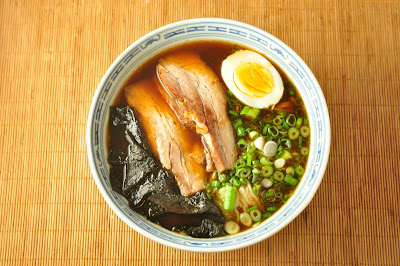

It all started when I found out about a Food Film Festival at Cinéma du Parc. I immediately bought tickets for a few select films. Among them was Delicatessen, about which I seriously wonder why it was included in this festival: it’s barely about food at all, although I suppose cannibalism is a type of gastronomy (and no, there was nothing about cannibalism in the synopsis, which makes the movie sound like a cutesie rom com - which, I assure you, it is not). We also saw Kings of Pastry, a documentary about pastry chefs taking the Meilleur Ouvrier de France exam. We witnessed some spectacular displays of sugar-pulling and sculpting skills – and some really nerve-racking brushes with catastrophe. It really makes you marvel at what people will put themselves through for their passion. There were also films I’d already seen, such as Chocolat and the exquisite Babette's Feast.

But my favourite discovery was Tampopo. I’d heard of it, and jumped at the chance to see it. It’s mainly about a woman who owns a ramen shop and is on a quest to make the best bowl of noodles ever. She enlists the help of a gruff trucker who really knows his way around a ramen kitchen, and other experts join along the way. But more than a film about ramen, Tampopo is a film about food and people who love food. There are various, seemingly random scenes inserted in the film focusing on anonymous characters and their relationship with food. Many of these scenes are absolute gold. This is one of my personal favourites. It's in Japanese, but basically the women are trying to learn how to eat pasta the "Western" way, without making any slurping noises, and... Well, see for yourself.

Ramen are still a major part of this film, though. The secret ingredients in the broth, the ideal resting time for the noodle dough, the ideal thickness of pork slices: everything is important. Even the way you eat your ramen is important. And here, I can’t resist linking to one of the film’s opening scenes, which addresses just this very question (and this one has subtitles).

I walked out of there with not much more than a vague idea of how to actually make good ramen (except that one must never let the soup boil – which I already knew from making pho), but a very strong desire to tackle this seemingly monumental task. So, I did some research. I came across a lot of recipes about how to make good broth and cook pork, but all of them used either dried noodles, or homemade egg noodles – and from what I understood, ramen noodles are supposed to be egg free (more on that in a minute). I read some good advice on the Chowhound forums, and some great posts on the blog No Recipes. And then, I discovered that David Chang’s Momofuku cookbook includes everything you need to know to make ramen from scratch. I found the book, flipped through it, drooled at nearly all the recipes, and took it home.

I lived in New York from 1988 to 1994, and my parents lived there again from 2003 to 2006. I visited them a lot during the latter period, but even though Momofuku Noodle Bar was already well known at the time, I never went there (I wasn’t nearly as interested in food as I am today). Having read the cookbook, this place is now on my list of musts for my next trip to NYC. The recipes seem full of bold flavours and unusual combinations, without a hint of pretension.

But my first concern was the ramen. The process was even more daunting than I’d expected. The first task was to make taré, which is described as “Japanese barbecue sauce.” Upon reading the ingredients, I realized this was basically what I and most people I know refer to as teriyaki sauce, only more complex: in addition to soy sauce, sugar, and mirin, this reduction had to include fond de volaille, made from roasting chicken bones. Ever since I learned to bone chickens, I’ve been buying whole birds and saving the carcasses to make stock, and I just happened to have one in the freezer. I’d never made fond before, and wasn’t too happy with the small quantity I ended up with. I’m not sure it made much of a difference in my taré.

The broth was next, an elaborate process of simmering chicken, dried and fresh vegetables, bacon, and pork bones for a combined total length of over eight – yes, eight – hours. I wasn’t sure I would be able to find pork bones: I was told most butchers probably wouldn’t have them on hand, because Western cooking usually revolves around stocks made with chicken and beef bones, and fond made from veal bones. Thank heavens for Asian supermarkets! I went to Marché Fu Tai and got some awesome-looking pork bones (leg and neck, from the looks of it), which the butcher sawed into segments for me. After the full eight hours, the stock was truly a thing of beauty: rich and fragrant, and as it cooled it turned into a gelatinous marvel. I seasoned it with the taré, following David Chang’s advice to keep flavouring until it’s “not quite too salty but almost.”


Chang uses two kinds of pork in his ramen, but I decided to skip the shredded shoulder and stuck to classic sliced pork belly. When I asked for pork belly at a butcher shop at Jean-Talon Market, the woman behind the counter apologetically said she only had a big, 4-pound slab, which was vacuum-packed and therefore couldn’t be divided. I lit up and told her that was perfect. The pork was rubbed with salt and sugar, then baked at high, then low temperatures (Chang writes that this method was born out of a mistake, but the result was so good he decided to keep doing it). It was mouth-wateringly tender and flavourful, and the leftovers were used for banh mi sandwiches.

And finally, there were the noodles. That was the part that had me most worried. I’d done research, and had learned that ramen noodles, contrary to what one may think, don’t contain eggs: they get their yellow colour from kansui, or alkaline water. Kansui also speeds up the production of gluten, and makes the noodles firmer. I found a comment on Chowhound that someone had managed to locate some of this hard-to-find liquid near Jean-Talon. I looked around and found some at Thai Hour. (On a side note, I was reminded never to judge a store by appearances: my first instinct was to check Marché Oriental, which is also in that neighbourhood. It’s the larger and better-lit of the two stores, so I thought I had a better chance. But no, I found the kansui across the street, at the much more modest-looking Thai Hour.)

I was tempted to hand-pull the noodles, as I had seen it done in the Oishinbo volume on ramen and gyoza (Oishinbo is an amazing manga about Japanese cuisine, which I have previously mentioned). The process just looks so bad-ass and impressive (this is unflipped manga, so read the panels right-to-left):


But I decided to save that experiment for another time, and just used the pasta roller, which is how Chang does it anyway. Incidentally, he commented on his own recipe by saying that the home cook didn’t really need to go to the trouble of looking for kansui, or even making noodles from scratch. But when people give me leeway in a recipe, I take it as a challenge to refuse said leeway. :-)

Okay, with all that done (it took about two days and a half), all that was left to prepare were the other toppings. Traditionally, ramen is topped with pork belly, half a hard-boiled egg, squares of nori, menma (softened bamboo shoots), scallions, and naruto (sliced fish cake). Naruto is usually storebought, and I knew where to buy some, but I could only get it in a relatively large chunk. Since I would only need a little bit, and have no use for this ingredient outside of ramen, the rest would have gone to waste. Besides, naruto doesn’t taste like much (although it does give ramen their distinctive “look”), so I had no qualms about skipping it. I also skipped the menma, mostly because I was tired of cooking and just wanted to eat the damn soup already.


I had to be reminded of how to boil an egg while avoiding that ugly grey ring around the yolk: put the egg in cold water, bring to a boil, turn off the heat, and let sit for 10 minutes, 8 minutes if you want the yolk to be ever so slightly creamy. (Chang tops his ramen with slow-poached eggs, which I also know how to make, but as I explained, I was kind of in a hurry to eat.)

It’s important for the broth to be hot when you ladle it, and the bowls should ideally be warmed in a low-temperature oven. The water for cooking the noodles should be simmering, not rolling: a full boil can strip away some of the flavour (Mind you, I haven’t tested this theory for myself, but that’s what Oishinbo says… Seriously, there’s a whole chapter about this). The cooking time varies depending on the noodles.

So, was it worth it? Oh hell, yes! It tasted out of this world. No, actually, it tasted like Japan, and took us right back to those narrow little ramen shops in Tokyo. The broth was amazing, the pork melted in our mouths… The noodles could have been more toothsome, but I’d had to improvise on them: the recipe called for alkaline salts, and all I had was alkaline water, so I had to guess the amount, and probably should have added a tiny bit more. But you can bet I’m going to keep tweaking this until I get it right.


So, that was my first foray into homemade ramen. I can’t wait to make more, and try other kinds of broths, especially miso. I faithfully followed the recipe for my first attempt, but now that I have a pretty food idea of the process, I want to come up with my own recipe, my own ideal ramen. Yummy days ahead!

Thursday, July 14, 2011

Daring Cooks' July Challenge - Homemade Noodles

Steph from Stephfood was our Daring Cooks‟ July hostess. Steph challenged us to make homemade noodles without the help of a motorized pasta machine. She provided us with recipes for Spätzle and Fresh Egg Pasta as well as a few delicious sauces to pair our noodles with!


This month’s Daring Cooks challenge couldn’t have come at a better time. I had been wanting to make pasta from scratch for a while now, and had already borrowed my father-in-law’s pasta machine even before the challenge was revealed (it also came in handy for the Daring Bakers’ baklava challenge).

I started off simple, by following the egg fettuccine recipe provided. The dough was very easy to work with. When cutting the pasta, the strands initially stuck together, and I had to finish separating them by hand. But I floured the next batches more thoroughly, and there were no other problems. I prepared the fettuccine very simply as well, a variation on aglio e olio: some garlic-infused oil, a crack of pepper, and some baby spinach thrown in with the pasta at the last minute. I would have liked the noodles themselves to be a little slicker, but I guess making pasta takes practice.


After that, I just had to make stuffed pasta: so many possibilities! My father-in-law had lent me a nifty little gadget to help with making ravioli.


Once the pasta is rolled, you place it over the cutters and stuff the pockets.


Cover with another sheet, run a rolling pin over, then turn over and press down.


And voilà! Just cut out the ravioli, and you’re done!

For the filling, I sautéed some finely chopped pancetta and portobello mushrooms, then mixed in some parsley, bread crumbs, and an egg. It wound up being a little too dry, and the sage-infused butter I used as a sauce did little to balance it. Normally, I guess one would have added ricotta, but nobody likes ricotta around here…


Ok, they’re not the most photogenic little morsels, either. Again, practice makes perfect.

I finished off this challenge with the dish I am proudest of: homemade ramen. Actually, I didn’t really think of this as part of the challenge: circumstances last week conspired to fill me with an irresistible urge to make ramen, and I spent four days running around looking for recipes and ingredients (when I get the urge to make something in particular, I tend to get a little obsessed). I didn’t think I would get this done before the deadline, but it turns out I was able to serve it for dinner last night.


I’m actually going to make a separate post about the making of this dish, so I won’t go into details here. I’ll just specify that I didn’t go so far as to pull the noodles by hand, which is the traditional way to make these. Instead, I used the pasta machine. So making the noodles themselves wasn’t much different from making pasta, except that the ramen dough was egg-free, and included a hard-to-find ingredient called kansui, or alkaline water.

This was definitely one of the most productive and inspiring challenges I’ve taken part in. Thank you, Steph! The rest of you can look at the challenge recipes here at the Daring Kitchen, and also go through the Daring Cooks’ blog roll to see what other kind of noodles were cooked up this month.

Sunday, April 3, 2011

Cauliflower Soup with Scallops

I’ve just gotten through a pretty intense couple of weeks. My apologies for the lack of posting here, as well as my lack of commenting on anyone’s blogs. But I finally got a proper night’s sleep on Friday, and woke up not feeling terrified of everything I needed to do – instead, I woke up feeling like it’s the weekend, which hasn’t happened in a long time (weekends have just been slightly more mellow work days, recently).

In other words, I’m back.

I admit Laurent has been picking up the slack, and doing most of the cooking recently (so I’ve at least been eating well, if not sleeping well). But I haven’t been completely absent from the kitchen, and so I have a soup to share with you today. It’s adapted from a recipe by Louis-François Marcotte.


Cauliflower and scallops are not something I would have thought to combine, yet once the idea was popped into my head, it seemed to make sense. This soup confirms that they actually work very, very well together. Marcotte’s original recipe uses light cream, but milk works as well, although you inevitably lose richness. He also adds a few mushrooms pickled in vinegar, but I personally think this overwhelms the delicate flavours of the main ingredients.

Serve this as an elegant first course, or a light main course (in which case you might consider adding more scallops).


Cauliflower soup with scallops
Adapted from Sexy: Cuisiner pour Deux, by Louis-François Marcotte

Serves 6 as a first course


1 leek, white part only, washed, sliced lengthwise, and chopped
1 head of cauliflower, washed and cut into florets
1 1/2 litre (6 cups) chicken stock
360 ml (1 1/2 cup) whole milk
18 raw scallops
2 tbsp butter
1 tbsp olive oil
Chopped dill, for garnish
Salt and pepper, to taste
6 dollops crème fraîche (optional)

In a large saucepan, melt 1 tbsp butter over medium-low heat. Toss in the leeks, salt lightly, and cook, stirring frequently, until leeks are tender. Add the stock and cauliflower, bring to a boil, and simmer until the cauliflower is very tender, about 30 minutes. Let cool and purée in a blender, or with a hand mixer. Return to saucepan and stir in the milk. Warm over medium-low heat, until soup is heated through. Keep warm until ready to serve.

Pat the scallops dry and season with salt. Melt the remaining tbsp of butter with the tbsp of olive oil in a skillet over medium-high heat. Sear the scallops under browned, about 1 minute on each side. Remove from the pan.

To serve: Divide the soup among heated bowls. Put 3 scallops into each bowl, spoon the crème fraîche in if using, sprinkle with chopped dill, season with freshly ground black pepper, and serve immediately.

Monday, May 3, 2010

When reality draws from fiction - Oishinbo-style Ramen


I think I’ve mentioned Oishinbo on this blog before, but never got around to elaborate on it.

Some of you may know that I read manga (Japanese comics) for a living. Sort of. I’m doing a PhD on Japanese popular culture, so I get to do a lot of fun stuff during the day (read comics, play games, watch anime) and pass it off as work. Of course, there’s a more serious aspect to this, too (such as reading phenomenological theory – which sometimes doesn’t come close to being fun), but all in all, I feel pretty blessed.

Honestly, the only way I could be happier was if I was writing my thesis specifically on food manga. Because there is a lot of food manga out there! Now, it’s a little too late to change my thesis topic, but it doesn’t mean I can’t read every culinary manga I can get my hands on!

One of my very favourite series is Oishinbo, written by Tetsu Kariya and drawn by Akira Hanasaki. It’s actually a very long-running series (in fact, it is exactly as old as I am), but recently, best-of anthologies have been translated into English.


Oishinbo is all about Japanese cuisine. It revolves around a journalist, who happens to be a very knowledgeable gourmet, and who is tasked with creating the Ultimate Japanese Menu – a process which ends up taking many, many years. So, throughout the story, he travels around Japan, trying out different dishes, and figuring out what makes them work.

Now, his father also happens to be a renowned gourmet – but they don’t get along very well at all. Inevitably, they run into each other, get into an argument about food, and… decide to settle it with a contest! They’ve done this with a wide array of Japanese dishes: sashimi, ramen, gyoza, onigiri, miso soup… you name it, they’ve battled about it. You can see why this appeals to the self-confessed food geek that I am. I mean, they’re getting all excited about food! And the suspense is always hilarious, going somewhere along these lines:

Taster: Ooooh, this rice is exquisite! It is so fluffy and light! It caresses the tongue! It is perfect! *he tastes the second batch of rice* Wait a minute! I was so wrong! I thought the first rice was good, but now I see that, compared to this one, it was nothing!

All joking aside, though, this series is hugely informative. It really teaches you the basics of Japanese cuisine, such as how to store rice, how to tell is a sake is legit, and how to make dashi (clear broth) from scratch. Also, each volume features one or two recipes, complete with quantities and instructions.


I want to share one of these recipes with you today. It’s a miso-flavoured pork ramen, that has the particularity of being made with katsuobushi dashi (katsuobushi is dried bonito, or skipjack tuna). Surprisingly, the smoky fishiness of the dashi works really well with the pork.

We love making this ramen at home. I’ve adapted the quantities a little, to make it a full meal.


Oishinbo-Style Miso Ramen
Adapted from the Oishinbo manga series (Ramen and Gyoza volume)

Serves 2

4-6 large shiitake mushrooms, cleaned, stemmed and minced
120 ml (1/2 cup) katsuobushi flakes (tightly packed)
1 litre (4 cups) water
4 tbsp soy sauce
200- 230 g (7-8 oz) fresh ramen (or substitute with dried ramen, or Chinese egg noodles)
3 tbsp hatcho miso (or substitute with red miso)
3 tbsp sake
1 1/2 tbsp sesame oil
3 garlic cloves, minced
1 large shallot, minced
150g (5 oz) lean ground pork
3 scallions, minced
Chinese chives, for garnish (optional)


Bring the 4 cups of water to a boil in a pan. Put in the katsuobushi flakes, turn off the heat, and let stand for 2 minutes, or until the flakes fall to the bottom of the pan. Strain the dashi through a sieve lined with cheesecloth (or paper towels). Stir in the soy sauce, and return the pot to medium heat to keep warm (the soup should be steaming).

Bring a large pot of water to a boil.

Dilute the miso with the sake. Reserve.

Heat the sesame oil over high heat in a wok, and fry the garlic for 30 seconds, or until it begins to release its aroma. Add the shallot and the pork, and cook for 3-4 minutes, stirring constantly.

Add the scallions and mushrooms to the pork mixture, and cook for 1 minute. Stir in the miso and continue cooking until the liquid has almost completely evaporated, but the mixture is still somewhat moist. Keep warm over low heat, and reserve.

Cook the ramen in the boiling water for 2-3 minutes. If using dried noodles, follow the packaging instructions. Drain and divide into bowls.

Pour the dashi into the bowls. Top with the pork mixture. Garnish with chopped Chinese chives if desired (or regular chives). Serve immediately.

Monday, December 7, 2009

Disaster à la di Stasio - Eggs in Ramekin and Mushroom Cappuccino


Any foodie who lives in Quebec knows about Josée di Stasio. We often turn to her book Pasta Et Cetera when we’re short on ideas to make pasta interesting. Her Italian-inspired recipes are always simple and full of flavour, with lots of useful tips and variation ideas.

This is even truer of her previous book, À la di Stasio, which we purchased a couple of weeks ago. Two whole pages on how to roast specific vegetables may not be of much use to seasoned chefs, but I’m certainly grateful for all that information. The recipes in this book are more diverse and less exclusively Italian, with a few Asian-inspired dishes and a couple of decidedly Northern recipes (duck and turkey tourte, anyone?).


I haven’t had much time to actually do many of the recipes in here, but there was one which I was particularly eager to make: her eggs in ramekin, where the ramekin is a flattened slice of bread lined with ham, buttered and baked in a muffin tin. Ever since I first saw this recipe (and the lovely pictures) over at Coco Bean, I’ve been curious to try it. Admittedly, since Christie and Ian were kind enough to post their adapted recipe, I suppose I could have just tried it then and there, without waiting to buy the actual book – I guess it sort of slipped my mind.

But, after I got the book, I procrastinated no more and made the eggs for Saturday brunch.


They were exquisite! So pretty to look at, and very tasty! It takes a bit longer than scrambled or fried eggs, but it’s still very easy to make, relatively healthy, and the presentation definitely makes an impression on people!

Not to be outdone, Laurent insisted on executing one the book’s recipes himself, the very same day. He opted for this:


You’re probably thinking he chose to make us cappuccinos, to go with that brunch. But no: this is actually mushroom soup, which we had for dinner that night.

“Mushroom cappuccino” had been on our radar for quite some time. We were first introduced to the concept at a potluck party, where a gourmet guest treated us to this lovely surprise. His version was quite different from the one in Josée di Stasio’ s book, consisting of a consommé, rather than a soup. The version we used is generally similar to the one found here, on Josée’s website (translation follows), except that the book recipe called for steamed milk, rather than whipped cream. We also added a sprinkling of Espelette chili pepper.

Laurent insisted on taking charge of supper, so I let him. Everything seemed to be going fine: the ingredients had simmered, and all that was left was to run them through the blender, and make the steamed milk with the espresso machine.

I was reading in the living room, when I heard the blender turn off, and Laurent gasp. It wasn’t a normal gasp. We often express ourselves vocally in the kitchen, whenever things go wrong, spill, or burn. But this sounded particularly drastic. When I asked what was wrong and got no answer, I dropped my book and ran into the kitchen.

The blender was covered in mushroom soup, which was slowly spreading across the counter, while Laurent was staring at it, in shock. It was as if the bottom of the pitcher had detached – which, as it turned out, was exactly what had happened. It had unscrewed at the worst possible time, just as Laurent was about to lift the pitcher from the base.

We stared in silence for a few seconds, then proceeded to doing something which I really shouldn’t be admitting to in public: we scraped the soup from the counter back into the pan and reheated it. Yes, it sounds gross, but… Laurent had spent over an hour working on that soup, in addition to shopping for all the ingredients, it would have broken his heart to throw it away! And honestly, haven’t we all done something similar when we thought no one was watching? Like scarf down the cookie that fell on the floor? Or taste the pastry cream with a finger? Besides, our countertop was clean… sort of.


At any rate, the soup didn’t seem too affected by this ordeal. It tasted delicious, and we will definitely be making it again – hopefully with less trauma. The steamed milk is definitely what makes this soup special. Next time, however, I might try to go with a consommé-type base, rather than a puréed soup, for a smoother, more cappuccino-like texture.

And in case you were worried about our blender… it made it out just fine. Laurent rinsed it and picked soup out of it for 20 minutes, and it’s as good as new.


Mushroom Cappuccino
From À la di Stasio

Serves 4

1 onion, minced
1 leek, white part only, minced
2 tbsp butter
450g (16 oz) mushrooms, sliced
1 small potato, peeled and diced
Salt and pepper, to taste
250 ml (1 cup) heavy cream
1 tbsp fresh thyme (or substitute with 1 tsp dried thyme)
30g (1 oz) dried porcini, ground (optional)
750 ml (3 cups) chicken broth

In a large saucepan, melt the butter over low heat and cook the onion and leek until soft. Add the mushrooms, raise the heat to medium-high and sautée until the vegetables release their liquid and it evaporates. Add the potato, salt, pepper and thyme.

Reserve 1 tbsp of ground porcini, and add the rest to the pan. Add the broth, bring to a boil and simmer half-covered for 15 minutes.

A few minutes before serving, stir in half the cream. Purée the soup with a hand-mixer or a blender, and keep warm.

Whip the remaining cream. Serve the soup in coffee cups, topped with a dollop of whipped cream and sprinkled with ground porcini.

Variation: Substitute half the cream, or all of it, with steamed milk, made with an espresso machine. Substitute the sprinkling of ground porcini with Espelette chili.

Monday, November 9, 2009

Late in the trend - Butternut Squash Soup


Halloween has come and gone, and I have nothing to show for it.

It seems like every food blogger out there was doing a pumpkin series. Except me. Why? To tell you the truth, I have never used pumpkin in anything. Ever.

I’m not sure why. When I was growing up in New York, there was pumpkin pie everywhere during the holiday season, but I was never a fan. Once, when I was five, my kindergarten class took a trip to a pumpkin farm just before Halloween. We were allowed to pick one pumpkin each from the patch and bring it home. I chose the biggest one I could find, so huge I could barely wrap my arms around it and carry it back to the schoolbus. My mom turned it into soup – soup that lasted for days and days. By the end, I was sick of pumpkin soup.

So, no pumpkin pie, and no pumpkin soup. And it never occurred to me that pumpkin could be used in any other way. Until I started foodblogging and discovered the wonderful preparations everyone came up with this month. Pumpkin bread, pumpkin doughnuts, pumpkin macarons, pumpkin shortbread, pumpkin cupcakes – and yes, soup and pie, too. Seeing so many people turn to pumpkin made me think that maybe it was time I revised my opinion on the Big Orange Guy.

But time got away from me, and before you knew it, Christmas decorations were being put up at the drugstore. Phooey.

So, still no pumpkin-related experimenting. However, I did get around to trying out another vegetable (technically a fruit) that I’ve been dancing around for a while now: the butternut squash.


I know. Everyone has cooked something with butternut squash at least once in their lives. Except me. I just seem to have something against cucurbitaceae. I’ve avoided pumpkin and squash and, while I do like melons, I rarely go out of my way to buy them. Cucumbers are the exception: I could eat cucumbers every day.

Honestly, the only time I ever bought a butternut squash was years ago, when I was an undergrad. My roommate and I were having a Halloween party, and I had bought some pumpkins to decorate – and also a butternut squash. I didn’t even know what it was called back then, I just thought it had a funny shape.

And then I tried to carve it.

How was I supposed to know a butternut squash doesn’t have the same structure as a pumpkin? I ended up with a sprained wrist, and a strong dislike of “whatever the hell that weird, pear-shaped vegetable was.”

But time has passed, and the proliferation of butternut squash recipes piqued my curiosity. So, a couple of weeks ago, I decided to try out this simple soup recipe from Christine Cushing. It was a bit rough getting the hang of peeling the squash, and I half-sprained my wrist again – but it was worth it this time.


It was delicious! I often make soups, whenever I have extra vegetables lying around, but this one was a real hit. I made it again barely a week later, and froze the (massive) leftovers for a rainy day. It has such a wonderful flavour! Laurent and I have decided that the butternut squash is a keeper.

I ended up tweaking the original recipe, namely omitting the pear C.C. puts in: while it certainly sounded good, I found it didn’t add much, and actually subdued the flavour of the squash. However, the inclusion of toasted pine nuts was definitely a plus.


Butternut Squash Soup
Slightly adapted from Christine Cushing

Serves 8-10

30 g (2 tbsp) butter
1 leek, white part only, chopped
2 medium carrots, peeled and chopped
1 onion, chopped
2 celery nibs, chopped
1 large butternut squash, or two small ones, peeled, seeded and chopped
1 1/2-1 3/4 liters (6-7 cups) chicken or vegetable broth
2 bay leaves
1/4 tsp nutmeg
Salt and pepper
1/2 cup pine nuts

Melt the butter in a large pot, over medium heat. Add the onion, leek, carrots and celery, salt lightly, and sauté until they begin to soften.

Add the stock, bay leaves and nutmeg, bring to a boil and simmer until the vegetables are very soft, almost done (about 15 minutes). Add the squash and continue simmering until tender (about 5-10 minutes).

Meanwhile, toast the pine nuts. Put them in a skillet over high heat, stirring constantly, until they begin to brown. Do not let them burn. When ready, immediately transfer the nuts to a bowl or plate, and let cool.

When the vegetables are done, remove the bay leaves. Purée the soup in a blender, or with a hand mixer. Reheat the soup and salt to taste. Divide into bowls, decorate with a few toasted pine nuts, sprinkle some freshly cracked pepper and serve immediately.