Saturday, July 23, 2011

Inspiration from Pop! - Goat Cheese Tart with Olives


I don’t blog much about restaurants here, mostly because I simply don’t consider myself enough of an authority to give an edifying review. Also, all things considered, Laurent and I don’t eat out all that much, just the two of us. We splurge every now and then to celebrate something big: a publication, a successful milestone (although, even for anniversaries, we tend to stay in and cook up our own feast). The rest of the time, when we eat out, it’s usually circumstantial. Sometimes it’s because we’ve both been too busy to cook that day, in which case we step out to one of the many casual places in our area. Most often, it’s because we have to be somewhere right after or before dinner (a movie, or a show), and it’s more convenient to eat in the neighbourhood.

Even then, we tend to return to the same places. And since today’s recipe is inspired by a restaurant, I thought I might as well mention the places we like to go. Around our place, we’ll go for sushi at Atami, a burger or onion soup at McCarold’s, or lemongrass chicken at Le Camélia. If it’s a nice day and we’re in the mood for really good Vietnamese food, we’ll walk all the way to Hoai Huong.

If we have to be downtown (for a movie or an opera), then it’s often Kazu. Yes, we’re part of those crazy people who wait in line on the sidewalk for thirty minutes to an hour (if we can, we try to show up half an hour before they open, since we know we’re going to have to wait at least that long anyway). And yes, we can feel the contempt in passers-by’s eyes, and we hear them whisper “What the hell, that’s just nuts!”, and on some days, when it’s cold or raining, we even start to feel a little ridiculous. But after we finally get a seat at the counter and take that first bite of okonomiyaki or 48-hour-pork, our faith is re-established, and we know without a doubt that this place is worth it. On days when time is too much of a factor, we’ll turn to Ba Le (they’re often out of their delicious homemade bread for their bahn mi sandwiches, but their pho is one of the best I’ve had) or the spiciness of Cuisine Szechuan.

When we have to be near the Plateau, usually to see a play at the Théâtre de Quat’ Sous, we experiment a bit more. Sometimes, out of nostalgia (I used to live in that area), we’ll grab a Portuguese chicken sandwich at Rôtisserie Coco Rico. We’ve tried out Big In Japan, but were disappointed. Recently, we’ve been going to Pop!, the wine bar affiliated with Laloux. We started going there because they used to offer a post-show menu deal, making it the ideal post-show destination (and for nights when we go to Espace Go, Leméac still offers a late night two-course meal at $25 – a real steal!). The deal is now gone, but we keep going back, because the food remains very affordable… and very good. Not to mention, we discovered a few very good wines.


The last time we were there, I had one of their “tartes salées” (savoury tarts), which are basically pizzas (in fact, I just saw that, amusingly, their online menu now refers to them as pizzas). The Marrakesh tart really blew my mind. Topped with goat cheese, olives, honey, and mint, it was both refreshing and hearty. It was so good I took the time to discern every ingredient (which wasn’t too difficult), and jotted them down when I got home, so I could try to recreate the dish. And I did.

I hesitated before posting this, wondering if it was ethically acceptable to copy a restaurant dish (just like I never post someone else’s published recipe if I haven’t adapted it). Normally, I would have tweaked it, but it seemed so perfect as it was, I didn’t feel the need to change anything. But it’s not like I asked for the recipe, and my result is certainly not exactly the same as the original: I’m pretty sure I used too many olives (we were really hungry when I made this), I may have missed a “secret ingredient” or two, and the crust is definitely not as good. But it’s still a decent effort, and I really wanted to share it with you. So, in homage to Pop!, here’s my version of their Marrakesh tart.

You can use any kind of pizza dough you like, although a thicker crust is preferable. I used Marcy Goldman’s Best Pizza Dough Ever, but was pressed for time, so I cut a few corners. It’s a good dough for thicker-crust pizzas. It yields enough dough to make 6 small tarts, but you can freeze any excess dough for future use.


Goat Cheese Tart with Olives
Inspired by the kitchen of Pop! Bar à vin

Yields two individual tarts

Pizza dough (adapted from Marcy Goldman’s A Passion for Baking)
1 3/4 cups warm water
2 tsp instant yeast
2 tsp sea salt
1 tbsp sugar
3 tbsp olive oil
2 cups olive oil
5 to 6 cups bread flour

Garnish
150g (5 oz) soft, fresh goat cheese
1/2 cup green olives, pitted and sliced (preferrably spicy)
1/2 cup Kalamata olives, pitted and sliced
1 tbsp coriander seeds
One handful of fresh mint leaves, coarsely chopped
1/2 tsp dried thyme
Honey, for drizzling
Cracked black pepper, to taste


In a large bowl, whisk together the water and flour. Stir in the salt, sugar, olive oil, and half the flour. Switch to kneading by hand (or use a stand mixer with a dough hook) and gradually add the rest of the flour, until you obtain a smooth, soft, elastic dough (about 15 minutes of kneading by hand). Spray the bowl and dough with oil, cover with plastic wrap, and let rise for 60 minutes.

Gently deflate the dough and cut off one third. Wrap the remaining two-thirds of dough tightly in plastic and freeze for future use. Divide the rest of your dough in two. Take one portion, place it on a lightly floured surface, pat it down with your fingers, and stretch it into a 23 cm (9 inch) disk. Fold the edges under, to make a thicker crust. Repeat with the second portion. Place a few pie weights (or dried beans) over the centers of the tarts, to prevent them from rising too much (Marcy suggests putting the toppings at this point, but I fear this could lead to a soggy dough; and in this case, the toppings really need to be added post-baking). Cover lightly with plastic wrap and let rise for another 45 to 60 minutes, until puffy.

Preheat oven to 240ºC (475ºF). Remove the weights from the dough. If the tarts have risen too much in the center, press them down lightly with your fingers. Place on baking sheets or pizza rounds, and bake for 15-20 minutes, until well browned.

While the tarts are baking, place the coriander seeds in a skillet over high heat, and toast, stirring constantly, until they are fragrant, about 1 minute or 2.

Whisk the goat cheese until smooth and creamy.

When the tarts are baked, garnish them with dollops of cheese, then sprinkle them with sliced olives, coriander seeds, mint leaves, and thyme. Drizzle with honey and season with pepper to taste. Cut into wedges and serve immediately.

Thursday, July 14, 2011

Daring Cooks' July Challenge - Homemade Noodles

Steph from Stephfood was our Daring Cooks‟ July hostess. Steph challenged us to make homemade noodles without the help of a motorized pasta machine. She provided us with recipes for Spätzle and Fresh Egg Pasta as well as a few delicious sauces to pair our noodles with!


This month’s Daring Cooks challenge couldn’t have come at a better time. I had been wanting to make pasta from scratch for a while now, and had already borrowed my father-in-law’s pasta machine even before the challenge was revealed (it also came in handy for the Daring Bakers’ baklava challenge).

I started off simple, by following the egg fettuccine recipe provided. The dough was very easy to work with. When cutting the pasta, the strands initially stuck together, and I had to finish separating them by hand. But I floured the next batches more thoroughly, and there were no other problems. I prepared the fettuccine very simply as well, a variation on aglio e olio: some garlic-infused oil, a crack of pepper, and some baby spinach thrown in with the pasta at the last minute. I would have liked the noodles themselves to be a little slicker, but I guess making pasta takes practice.


After that, I just had to make stuffed pasta: so many possibilities! My father-in-law had lent me a nifty little gadget to help with making ravioli.


Once the pasta is rolled, you place it over the cutters and stuff the pockets.


Cover with another sheet, run a rolling pin over, then turn over and press down.


And voilà! Just cut out the ravioli, and you’re done!

For the filling, I sautéed some finely chopped pancetta and portobello mushrooms, then mixed in some parsley, bread crumbs, and an egg. It wound up being a little too dry, and the sage-infused butter I used as a sauce did little to balance it. Normally, I guess one would have added ricotta, but nobody likes ricotta around here…


Ok, they’re not the most photogenic little morsels, either. Again, practice makes perfect.

I finished off this challenge with the dish I am proudest of: homemade ramen. Actually, I didn’t really think of this as part of the challenge: circumstances last week conspired to fill me with an irresistible urge to make ramen, and I spent four days running around looking for recipes and ingredients (when I get the urge to make something in particular, I tend to get a little obsessed). I didn’t think I would get this done before the deadline, but it turns out I was able to serve it for dinner last night.


I’m actually going to make a separate post about the making of this dish, so I won’t go into details here. I’ll just specify that I didn’t go so far as to pull the noodles by hand, which is the traditional way to make these. Instead, I used the pasta machine. So making the noodles themselves wasn’t much different from making pasta, except that the ramen dough was egg-free, and included a hard-to-find ingredient called kansui, or alkaline water.

This was definitely one of the most productive and inspiring challenges I’ve taken part in. Thank you, Steph! The rest of you can look at the challenge recipes here at the Daring Kitchen, and also go through the Daring Cooks’ blog roll to see what other kind of noodles were cooked up this month.

Saturday, July 2, 2011

Joanne Fluke's Devil's Food Cake Murder - Raspberry Vinegar Cookies

I don’t browse in bookstores much these days. When I visit Renaud-Bray, or Indigo, I usually have a pretty good idea of what I’m looking for. The truth is, my to-read pile is towering high enough as it is, no need to add serendipity to the mix!

The exception is cookbooks, because browsing is just part of the process of discovering good recipes – and also because it’s hard for me to resist the cookbook aisle. But there’s another context in which I allow myself to browse through books: the airport.

I always pack a book when I leave on a trip. Because iPods can malfunction, and Nintendo DS consoles can run out of juice, but it’s pretty hard to get into a situation where you can’t crack open a good novel (although I do remember a nocturnal transatlantic flight where neither the TV screens nor the reading lights were working, and they wouldn’t leave the main lights on because some people wanted to sleep – that was a long nine hours). But I’m always afraid of running out of reading material, and there’s not a whole lot to do in airports, so I always wind up spending a lot of time at the bookstore. They don’t have a lot of choices, and most of their books are either trendy or lowbrow, but it gets me to look at books that I normally don’t even glance at.

Another recent trend in my reading habits is that I am irresistibly attracted to any book that has to do with food. I’m not talking about factual books: I do pick some of those up on occasion (why wouldn’t I want to learn all about the history of salt?), but I know a lifetime wouldn’t be enough to read everything that’s out there. No, I’m talking about fiction that revolves around food. It’s gotten to the point where I snatch up anything that has a food-related word in the title. In The Kitchen, The Particular Sadness of Lemon Cake, Le cuisinier – it’s all good. Sometimes, the book ends up not being much about food after all, but it's always interesting to see where food does factor in.

It’s not always great literature, of course. But I’m a versatile reader, and I like a little bit of everything in small doses, so I’m usually content, even if I have yet to have my mind blown. Recently, however, I read a food novel that reassured me that I still have standards: Joanne Fluke’s Devil’s Food Cake Murder.


I picked this one up at, you guessed it, the airport. At first glance, it looked right up my alley: a young female baker who solves crime on the side, how could I go wrong? The main character even has a mischievous and demanding cat, something I can definitely relate to. But in the end, I was disappointed.

Of course, one needs to keep in mind that this is part of a long-running series, with recurring characters and themes. So, not having read any of the previous books, it’s understandable that I had a little difficulty relating to the giant cast of characters, most of whom were introduced without any major description or development, with the assumption that the reader was already familiar with them. Fair enough, but a good book should be able work around this problem, and involve new readers even in the middle of a series.

Worse than any format-related issues, however, was the fact that the style was mostly flat, the vocabulary unimaginative. See for example the heroine’s account of an awkward scene with her beau: “He left a couple of messages, but he sounded… […] cold. He sounded cold like he was talking to a stranger. And when he came back he was cold, too. He gave me a hug and thanked me for keeping [his cat], but… he was cold. I don’t know any other way to describe it.” Evidently not. Of course, I’m aware that this is a light series, not a Virginia Woolf novel: it’s meant to be read casually, not dissected. But fun books can be well-written, too – or at least use synonyms.

The crime story itself was decently entertaining, albeit not without its plot holes – but I’ll give that a pass, as I’m pretty sure the sleuth aspect is not supposed to be the main focus of this series. But there were some seriously awkward moments in the dialogue, which, along with the stylistic problems, made me keep a sceptical distance from everything – and I’m usually a pretty immersed reader. Some conversations felt like filler, more than anything else. I think the worst moment, for me, was a character’s reaction to a murder by shooting: “He was shot? […] Oh, dear! That’s just awful! I wish he’d been stabbed, or bludgeoned, or smothered, or something.” This insensitive response is followed by a page-and-a-half long rant where the character expresses her fears that politicians will use this incident to enforce gun control in their state, and goes on to enthusiastically explain why guns are both fun and useful. Regardless of anyone’s personal stance on the issue, that just came out of nowhere, and was in poor taste to say the least.


Okay, but what about the food? After all, it was the food theme that initially drew me to this book. Well, the good news is, there’s a lot of it in this book, and not just sweet stuff: in addition to the devil’s food cake mentioned in the title, you’ll find cookies, bars, soup, brisket, and even a special cake for cats (which looks so incredibly rich that I would never dream of giving even a teaspoon of the stuff to my kitty Paprika). People eat so much in this book, it’s amazing they don’t all have waistlines a yard wide (maybe they do, but with the lack of description, how am I to know?). But there isn’t much in the way of food description: dishes are succinctly described as “wonderful,” absolutely perfect,” or “delicious.” Not quite enough to get my mouth watering.

There are, however, recipes included for nearly all the treats and dishes mentioned in the book, which gives us a little more insight into how all these “delicious” morsels actually taste. Most are intended for novice bakers and cooks, with very detailed instructions and easy-to-find ingredients. One recipe in particular caught my eye, but more because of the title ingredient than because of the characters’ reaction to it: raspberry vinegar cookies. I was curious as to how these could possibly taste good, so of course I had to try making them.

In the end, the vinegar wasn’t a flavour factor at all: its role was just to interact with the baking soda and create a chemical reaction, leading to a particularly light, aerated cookie. Maybe I was heavy-handed with it, because my cookies came out especially brittle, whereas they were supposed to be more similar to shortbread in texture. Regardless, I really liked these cookies (infinitely more than I liked the book), and they seemed to please people when I brought them to a meeting. The only downside to their brittleness was that everyone ended up with crumbs on their shirts…

I haven’t changed much to the original recipe, just added more pecans, and made the cookies a little bigger.


Raspberry Vinegar Cookies
Slightly adapted from Johanne Fluke’s Devil’s Food Cake Murder

Yields 3 dozen

200g (1 cup) butter, softened
190g (1 cup) sugar
1 tsp raspberry vinegar
1 tsp baking soda
1 tsp rum extract
210g (1 1/2 cup) flour
375 ml (1 1/2 cup) chopped toasted pecans

Preheat oven to 160ºC (325ºF).

Cream the butter with the sugar. Mix in the vinegar and the baking soda, then the rum extract. Add the flour, and stir until well incorporated.

Line four baking sheets with parchment paper. Drop tablespoonfuls of cookie dough onto the sheets, spacing them out (about 9 cookies per sheet).

Bake the cookies in batches for around 20 minutes, until golden around the edges and on top. Let cool on sheets for two minutes, then transfer the cookies to a wire rack and cool completely.

Store in an airtight container.

Monday, June 27, 2011

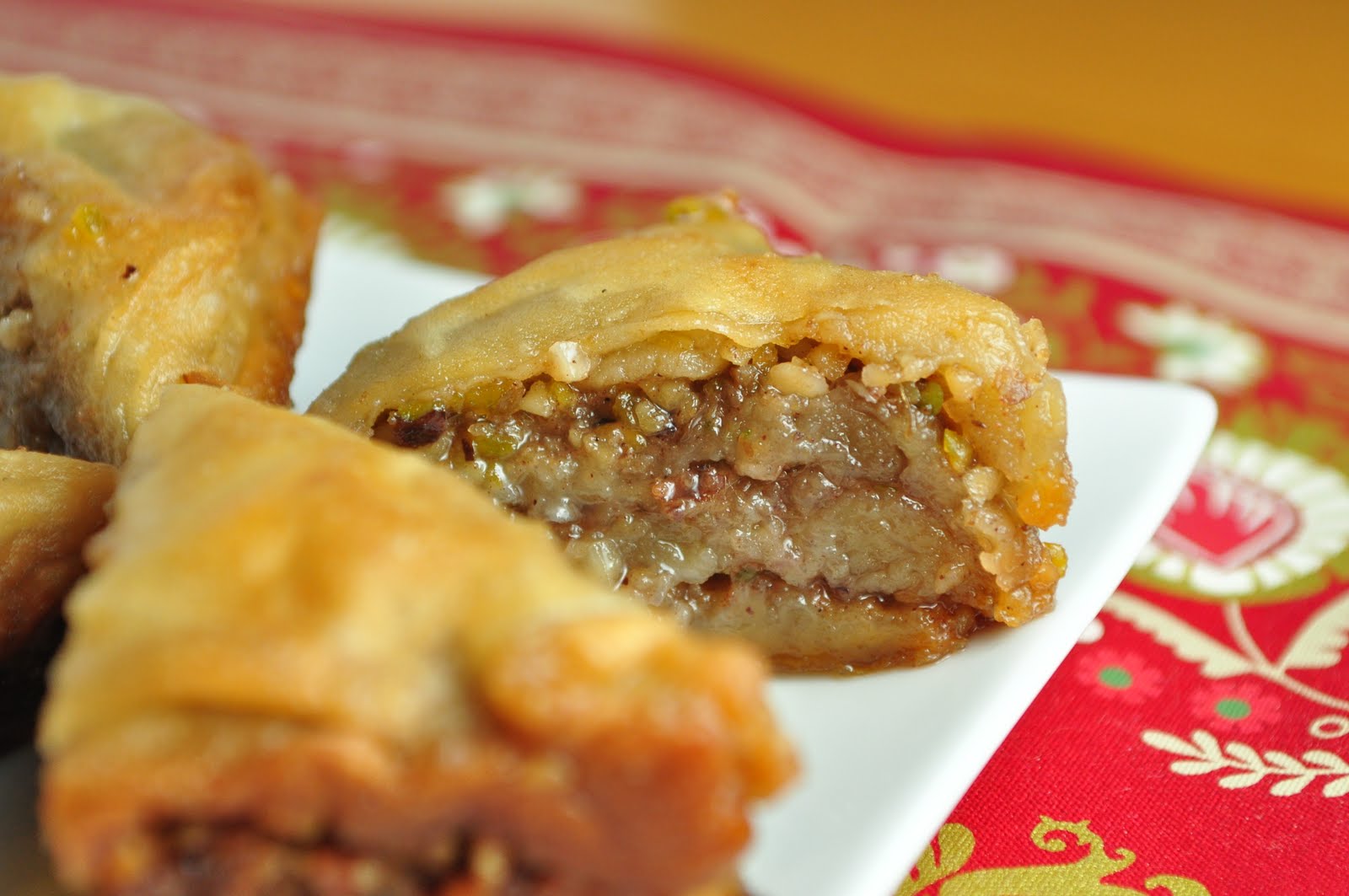
Daring Bakers' June Challenge - Phyllo and Baklava

Erica of Erica’s Edibles was our host for the Daring Baker’s June challenge. Erica challenged us to be truly DARING by making homemade phyllo dough and then to use that homemade dough to make Baklava.

When I first read about this month’s Daring Bakers’ challenge, I thought: “Oh, baklava. Cool. I know where to buy some nice phyllo dough, and – Wait, it has to be homemade phyllo? … Now that’s a challenge!”


It feels like it’s been a while since there’s been a truly hardcore DB challenge. I think the last one that had me quaking in my boots was the January one, the entremets. Not that any of the challenges since have been boring or too easy. Some were whimsical and creative, such as the edible containers challenge, others revolved around something not particularly difficult, but that I was glad to have the opportunity to make, such as the panna cotta challenge. But making your own phyllo? That’s on another plane altogether.


My father-in-law got all excited when I told him about it. He offered to lend me his pasta machine, to help get the dough paper thin. Since I’d been meaning to borrow the machine anyway, I gratefully accepted, and promised a full report and a share of the resulting dessert in exchange. I know I’ve said this before, but having in-laws who live just down the street and have an over-equipped kitchen is just wonderful for completing these challenges.

As it turns out, though, the pasta machine really wasn’t necessary, or even ideal. I made the dough and kneaded it by hand. It was soft and supple, and reminded me of the strudel dough I made for my second ever DB challenge. The pasta machine could certainly get the dough to super-thinness, but it was an obstacle to getting wide sheets. So I ended up running the dough a couple of times through the machine, to a moderate thinness, then stretching manually to finish the job.


It really wasn’t as difficult as I’d expected, just time consuming. To tell the truth, I was pretty tired by the end, but that was mostly because I’d been cooking all day: it was a holiday (Saint-Jean-Baptiste), and I went a little overboard with the cooking projects. In addition to the baklava, I made bread, ribs, and barbecue sauce. Fortunately Laurent pitched in and took care of the chicken stock, coleslaw, and oven fries.

One unexpected problem was that I ran out of dough before I could get enough sheets. And the sheets I did have were, for the most part, barely big enough to cover my 9x9 baking dish. So, I settled for using a 9x5 loaf pan, and using only three sheets per layer, as opposed to five.


Honestly, once the phyllo dough is ready, baklava is a cinch to make. The filling consists of nuts, spices, and sugar, and can be made in seconds with a food processor. Assemblage is just layering buttered phyllo and alternating with the filling. Anyone can do it. There’s also a quick syrup to cook up and pour over the baked baklava. And that’s all there is to it.


The filling tasted great. The phyllo, to be honest, could have been crispier. I suspected I put too much syrup, even though I had halved it to fit the size of my baklava. But I’m glad to have given homemade phyllo a try, if only for the bragging rights.


My thanks to Erica for a true blue challenge. Please check out the challenge recipes here, and go through the Daring Bakers’ blog roll to see how everyone else has risen to the occasion!

Tuesday, June 21, 2011

Oops! - Cranberry-Pistachio Cornmeal Biscotti

I made these cookies for Christmas and forgot to post about them!


Shame on me, I know. But I figured they wouldn’t be completely out of season: after all, cranberries and pistachios aren’t reserved for the holidays, and cookies are good all year round, as far as I’m concerned. Furthermore, these biscotti are made with cornmeal, which keeps them crumbly and not too hard: you can easily eat them without having to dunk them into a cup of hot coffee, and can savour them alongside an iced mocha instead.


Made from a recipe by Martha Stewart, these biscotti were my first attempt at this type of cookie. It was quite easy, with my only problem (as far as I can recall) being keeping the fruit and nuts from popping out of the dough as I shaped it. They also kept beautifully.


You can find the recipe here. Enjoy!

Thursday, June 16, 2011

Daring Cooks' June Challenge - Potato Salad

Jami Sorrento was our June Daring Cooks hostess and she chose to challenge us to celebrate the humble spud by making a delicious and healthy potato salad. The Daring Cooks Potato Salad Challenge was sponsored by the nice people at the United States Potato Board, who awarded prizes to the top 3 most creative and healthy potato salads. A medium-size (5.3 ounce) potato has 110 calories, no fat, no cholesterol, no sodium and includes nearly half your daily value of vitamin C and has more potassium than a banana!

Bet you thought I was gone for good, huh? Actually, I’ve been away on holiday for the past two weeks. We visited my parents in Strasbourg, then drove up to Belgium to visit other relatives. Overall, it was a pleasant stay, except for all the concern about the E coli outburst in Germany. My mother was especially worried about it, so we had to steer clear of cucumbers and tomatoes until the source of the bacteria was found. The culprit, as you know, turned out to be organic sprouts – and, ironically enough, we did have bean sprouts once, at a Vietnamese restaurant. Fortunately, there were no consequences.

Anyways, when we got home last night, the first thing I did was make a gazpacho. Oh, delicious glutamatey tomatoes, how I missed you! And you too, cucumber, salt’s best friend!

Now, believe it or not, I did plan ahead for this trip, and had a few posts already typed up, with photographs pre-selected and uploaded onto my travel netbook: I was all prepared for posting on the road. However, as I mentioned in my last post, I’ve been having some problems with Blogger. At first, I thought it was just because of Internet Explorer 9, but then there turned out to be other problems, which affected my ability to comment on other blogs, among other things. So, if you haven’t received a comment from me in weeks, it’s not just because I’ve been travelling, it’s also because Blogger wouldn’t let me! So, rather than tear my hair out in front of my low-capacity netbook during my vacation, I decided to just steer clear of the blog until I got home, for sanity’s sake.

But enough about that. Let’s talk about this month’s Daring Cooks challenge. You’ve probably figured out that the reason I’m posting late is that I only got home yesterday evening.

I admit I was underwhelmed when I first found out about the challenge: “exciting” isn’t exactly the word that most readily comes to mind when you think about potato salad. On the other hand, I was grateful for the challenge’s simplicity, as I had precious little time to get it done before leaving. Laurent’s father pitched in, as he often does, by giving me a bag of small potatoes, which he himself had received from someone.


I have no idea what kind of potatoes these were. But they were firm, like fingerlings, and perfect for salads.

I rather felt like improvising, for once, instead of following the challenge recipes. Potato salad isn’t a staple on our table, but we have made different versions at different times. And, although potatoes have a bad rap for being starchy, carb-y, and figure-unfriendly, our hostess was quite right to insist that the potato is an essentially healthy and nutritious ingredient, provided it’s prepared right. You can literally live on boiled potatoes, which you can’t do on bread or rice alone.

Anyways, I flipped through my potato-themed cookbook (because of course I have a potato-themed cookbook), and came upon a recipe which called for smoked salmon (of which I had a slab in the fridge that was in need of being eaten) and tarragon (one of my favourite herbs). The light, oily dressing also appealed to me: I’ve never been a huge fan of mayo-based dressings – Caesar salads excluded.


The potatoes were roasted for this salad, not boiled, which made for an interesting texture. Other than that, the capers, cornichons, and vinegar gave it plenty of acidity, which I also liked. I changed a few things from the original recipe, adding more tarragon and cutting back on the oil. All in all, it was a good meal, and a salad I’m glad to have tested.

I may be late, but it’s never too late to check out the challenge recipes, as well as the other Daring Cooks’ deeds! See you all soon!


Smoked Salmon Potato Salad
Adapted from Paul Gayler's Tout un plat – Patates

Serves two as a meal, four as a first course

400g potatoes
2 tsbp olive oil
Salt, to taste

For the dressing:
1 tbsp olive oil
1 tbsp xeres vinegar
Freshly ground pepper, to taste

For garnish:
2 scallions, finely sliced crosswise
10 cornichons, finely chopped
2 tbsp capers, rinsed
2 hard-boiled eggs, chopped
2 tbsp tarragon, chopped
200g smoked salmon, sliced and cut into bite-sized pieces


Preheat oven to 190ºC (375ºF) Scrub the potatoes clean and cut them into bite-sized pieces. Drizzle them with oil and toss until they are evenly coated. Place on a baking sheet or roasting pan, and roast for 30 minutes, or until the potatoes are cooked through, turning the potatoes over two or three times in the process. Sprinkle with salt and let cool until just warm. Transfer to a salad bowl.

Combine all the ingredients for the dressing, drizzle over the potatoes, and toss. Add the scallions, cornichons, capers, eggs, and tarragon, and toss to combine. Divide among plates, and garnish with smoked salmon.

Saturday, May 28, 2011

Daring Bakers' May Challenge - Chocolate Marquise on Meringue

Finally, I can post again! I've been having some tech issues, and it turns out Internet Explorer 9 was to blame. "Compatibility view" were the magic words, this time.

So, without further ado:

The May 2011 Daring Bakers’ challenge was hosted by Emma of CookCraftGrow and Jenny of Purple House Dirt. They chose to challenge everyone to make a Chocolate Marquise. The inspiration for this recipe comes from a dessert they prepared at a restaurant in Seattle.


This challenge was pretty intimidating at first glance: lots of components, some of which appeared to require many, many steps. A semi-frozen chocolate concoction served atop a pillow of torched meringue, drizzled with flavoured caramel and served with spiced caramelized nuts. All of it homemade.

Not only that, but the recipe looked absolutely huge. Eleven egg yolks plus four whole eggs just for the marquise part? I was reluctant to try a new recipe when so many ingredients were at stake: what a waste if it were to fail! But the incredible Audax was kind enough to do the math for everyone and provide us all with half and quarter recipes. The quarter version was just right for me.


I think I was most excited about using a blowtorch for the first time. I didn't have one, but I knew where to borrow one. Predictably, the meringue browned almost instantly, so I didn't get to play for very long, but it was fun while it lasted. I felt a bit guilty enjoying it so much, as I had just finished reading Gabrielle Hamilton's memoir, Blood, Bones & Butter. When she mentions the years she spent working in the catering business, cooking trendy (read: pretentious) morsels from which she resolutely steered away when she opened her own restaurant, she cites using a blowtorch as one of the symbols of the kind of cooking she never wanted to do again.


But, as Laurent wisely reminded me, neither of us are Gabrielle Hamilton, nor have we been cooking as long or as intensively. So, I will continue to gleefully shriek "Burn, baby, burn!" the next few times I use a blowtorch.


Right, so, on with the other components. The most uncertain one, for me, was the marquise itself. Having never made nor tasted one, I had no idea how it was supposed to look before being frozen. Was my mixture too thick, too runny? Was my syrup hot enough, were the eggs sufficiently fluffy? Then, when I cut squares out of the frozen chocolaty block a couple of days later, I wondered if it would thaw properly, or if it would just melt like ice cream and end up in a puddle on top of my meringue.


I needen't have worried: the marquise was silky smooth on the tongue, and, honestly, worth the effort. I spiked it with Triple Sec (orange liqueur) instead of the suggested tequila, and added some lemon zest as well. I will never get tired of chocolate and citrus.


The salty caramel and the sweet, slightly spicy nuts were also great additions to this dessert. This is something I would make again when I need to impress people. And, while it's quite a bit of work, you can spread it out over a few days, even make the marquise weeks ahead and freeze it.

You can find the challenge recipes here. Don't forget to look at the other Daring Bakers' blogs, to be amazed and inspired!